

How to plan to facilitate learning
Supporting information for planning
Many links for planning are located on the Pedagogy directory. This page specifically addresses: procedures and suggestions on how to plan to facilitate learning or teach. how to create lesson plans, units of study, and yearly plans for subjects, themes, or topics in a traditional curriculum or a more broad real world contextual orientation of integrated studies.
Examples not include on this page are:
- The big picture of planning has resources under the heading of curriculum planning and development resources in the Pedagogy directory.
- The actual practice of teaching and reflecting on decision making is referenced in the teaching section of the Pedagogy directory.
Overview
All planning documents are for communication: communication to ourselves as memory devices, communication to those who are interested in the education of students, communication to those who desire assessment information for accountability, and communication to students.
Planning documents include: mission statements, philosophies, principled procedures, action plans, lesson plans, units, year plans, multigrade curriculums and assessment plans. They can be organized for different durations, grade levels, and information to learn.
Documents should be organization to communicate the relationships between the four general areas of planning.
- Introductory information: beliefs, philosophies, rationale, mission statements, action plans, principled procedures...
- Content: what students are to learn
- Instructional procedures: how learning might be facilitated - including activities...
- Assessment.
Information related to these four areas overlap and require creative ways to communicate how the information is linked within and among them. While it is possible to divide a document into the four areas, it is more common to use other categories to organize information and let these categories blend into each other.
Suggestions for creating planning documents, kinds of information to include, and support resources. When information is gathered, consider how to organize the information.
While there are many different ways to organize information in a planning document here are two generic outlines for short sequences - units and longer year(s) planning. They can be copied into a word processor and used by adding, deleting, and organizing information as required. The two documents are similar in nature, however, it should be noted a year plan is more global in nature, until a point where planning becomes more specifc and turns into a unit type plan. The more global a plan the more information that has to organized and relationships shown. Therefore, year plans tend to have more tables and matrices. If you already have ideas for planning and categorizing information, then the outlines can be used more as a check list to see if the information included is as comprehensive as required.
Creating planning documents
One way to organize your thoughts is to begin by brain-storming: lists, narratives, tables, matrices, webs, diagrams, ...
Decisions on selection of what to include is decided by the author's best guess, based on theories and considerations for Planning to Facilitate Students' Construction of Concepts and Generalizations along with other elements of planning each person believes are most necessary to prepare to provide the best opportunity of students to learn within your classroom organization.
Elements include a choice of procedure for each activity, which should be based on a learning theory (common knowledge construction model, learning cycle, cooperative learning, direct instruction), and developmental theory as appropriate for the students. Other elements include how to communicate what is to be learned: concepts and generalizations, objectives, and at what level Bloom's Taxonomy for planning objectives, questions, and activities and instructional strategies with in each plan along with good directions and good questioning and classroom management .
All of these ideas in one way or another can be combined into a plan. To assist in helping remember what is most important teachers can create an outline or framework to consistently organize their ideas, which can be very generic or loaded with details. Once a framework is selected, then information is added to it.
Below are frameworks for planning information that outstanding teachers have available when planning and teaching - concept related planning information.
Concept related information and unpacking
- Planning Matrix for Bulbs and Batteries
- Planning Web for Mathematics Probability
- Considerations for Planning to Teach Concepts and Generalizations
- Category Explanations for Planning to Teach Big Ideas, Concepts or Generalizations
- Blank Concept Map
- Sample Concept Map for Sound
- Sample Concept Map for Classification
- Sample Concept Map for Mathematics Topic of Area
- Sample Concept Map for Dystopian Society
- Map or matter
All of these ideas come together to create a plan. Plans can be for one activity or they can group different activities into longer units of study. When considering activities it is helpful to review a list of real world ideas that can focus on ideas ore issues that have real world relevance.
There are many plans on this site most can be found in the subject areas that most closely fit the main ideas of each. Below are some shorter plans to focus on single activities and longer planning ideas follow that list.
- Probability with one die - linear plan, plan on a chart
- Probability sum of two die - linear plan, plan on a chart
- Probability with tiles in a sock - combines activties
Walk through of some planning development
Thoughts and reflections for a study on:
All plans can have strengths and weakness. One way to assess then is to create an assessment list of quality attributes for lesson plans.
From single plans to sequences
Planning guide for learning sequences or units.
The following sequences offer a variety of ideas and are in different states of completness.
- Air Sequence - focused elements -physical science content, learning cycle (exploration, invention, expansion), grade range 2-5..
- Electric Current Sequence - focused elements - middle school or higher, content areas (inquiry, unified processes - model, and other science ideas).
- Reading and Writing Numbers with Numerals and Words - focused elements content (place value, patterns, and number communication)
- Card Trick Sequence - focused elements - content (problem solving, reasoning and proof, and patterns)
- Rounding Numbers - focused elements - content easurement and body proportion concepts of rounding.
- Mixing 4 different colored water solutions - focused elements -focus questions for content and processes. Discussion questions include questions for both.
- Animals and environments - Gerbils for kindergarten, grade one or two
Unit planning walk throughs
- Language Arts book study for "The Mitten" with six language dimensions
- Physical science content Area Plan for Light unit with creation discussion - grade 4+
- Physical science content Area Plan for Sound unit with creation discussion grade 2+
- Complete physical science content Area Plan for - density.pdf and accompaning assessment data base .pdf
Integration
Lessons or instructional sequences can be classified by the kinds of integration. Four examples:
- Lesson or lesson sequence that focuses on one idea - no integration,
- Lesson or lesson sequence that focuses on one subject with integration of different aspects or dimensions of the subject - subject with dimension integration or integration within one subect.
- Subject integrated with dimensions of the subject - integrated science subject with dimensions: content - life science: biodiversity, ecosystem services; cross-cutting: stability and change; technology: making and evaluating solutions in a 5E learning cycle instructional procedure or model
- Subject integrated with dimensions of the subject - integrated science subject with dimensions: content - relaltive position and motion | seeds |
- Subjects integrated with dimensions of subjects - Notes for Planning Sound sequence with Subjects Integration
- Density - Unit with many activities, pop float, wood, metal, plastic, integrated properties, variables, operational definitions Assessment data base for density related concepts*
- lesson or lesson sequence that focuses on multiple subjects with integration of different subjects which may include dimensions for each of the included subjects or not - subjects integration with or without integration of dimensions, Sample Theme based planning document with integration of subjects, human devleopment, and career.
- lesson or lesson sequence that defines contextual dimensions other than subject related, sometimes call real life integration or integrated studies.
- Nonsubject integrated. Integrated with four context areas and school goals - Perspectus for Real Integration school and how to plan units of study based on a big idea or theme around world contexts and school goals. None subject orientation
Yearly - Parts and pieces for the development of year plans
Specific Instructional Methodology
---------------------
Excellent
Online Monograph
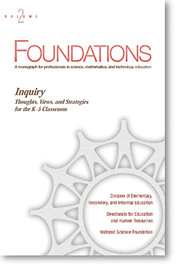
FOUNDATIONS:
A monograph for professionals in science, mathematics, and technology education interested in Inquiry
Thoughts, Views, and Strategies for the K-5 Classroom
-------------------
-------------------