Teacher Planning Steps: Considerations for Planning to Facilitate Students' Construction of Big Ideas, Generalizations, and Concepts
Overview
This article outlines essential elements for planning.
- Initial planning areas and ideas
- Creating a planning document categories
- Sample planning map or diagram
- Final reflections
Initial planning
- Identify a topic or big idea (generalization or concept) important for students to know and relevant to their every day existence. May reference the standards or curriculum for suggestions.
- Unpack the big idea (generalization or concept) by describing all facts, properties, concepts, and relationships necessary for students to construct the big idea, to explain it well, what it is and isn't, and how it is used in real life. Consider the students' developmental levels. The age and previous experiences, which will impact how they will be able to understand and conceptualize the facts, properties, concepts and generalizations.
- Identify and describe student's initial perceptions, which may be partially accurate or misconceptions.
- Identify introductory ideas. Focus questions, initial assessment, maybe problems to solve, discrepant events, and ideas for activities to focus students' thinking and diagnose their initial understandings.
- Review all this information and sequence it starting with the initial perceptions or students' existing understandings, discovered in an initial assessment activity, and build a sequence from the lowest level or initial perceptions to the highest level of understandings expected of students for the big idea and related ideas.
- Use the sequence (hierarchy or trajectory) of information along with developmental theories(child and adolescent or historical development of subject matter) to consolidate and organize levels of understandings to use for assessment (scoring guides or rubrics).
- Identify activities as opportunities for students to continue their learning from their present understanding and move toward achieving greater understanding for the big ideas or learning goals and outcomes. Matching activities to the different facts, properties, concepts, and generalizations checking to see if all necessary information will be available for students to construct the identified big idea and related ideas with suffcient depth and breadth relative to the students' development.
- Sequence the activities: Start with an activity (discrepant event) that give students opportunities tofocus on the ideas and experience cognitive dissonance. Continue to identify activities as opportunities for students to construct all the necessary ideas for the big idea. If the plan includes multiple concepts, repeat this procedure for each one, and finally activities that demonstrate the relationships of the concepts to create relationships or generalizations.
- Identify and note any instructional model or syntax with procedures for the sequence and activities as needed.
Create a planning document
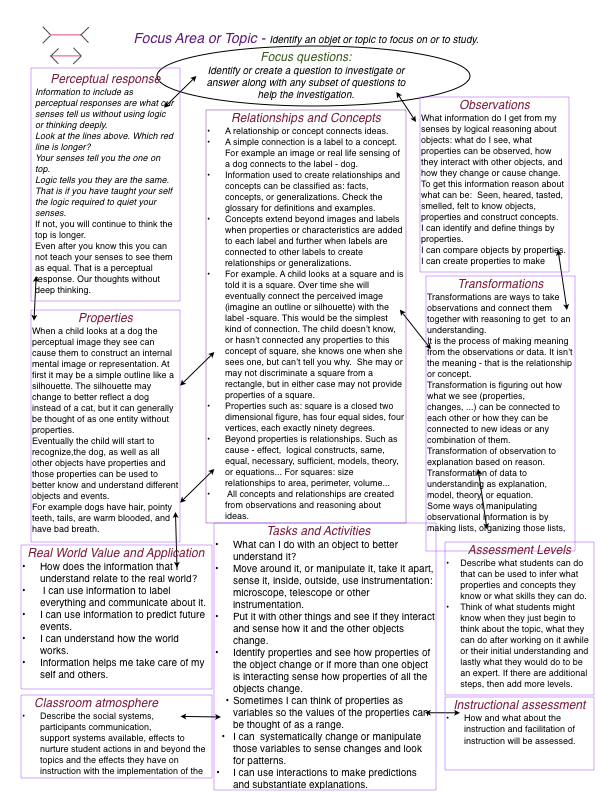
Planning map categories related to a general teaching model
- Perceptual information - what students know (visual gut reaction way of knowing. Naive ideas which may or may not be misconceptions;
- Observations made by students for which initial information or ideas are derived to use as facts, ideas, concepts, generalizations … to reason with.
- Facts and properties are information used to construct
- Concepts and generalizations are how the facts and properties are related for big ideas.
- Transformations - bridges or transformations are charts, graphs, maps, webs, illustrations, outlines, classifications that combine facts, concepts, generalization with reasons and explanations for concluding or constructing the concepts and generalizations. These connect the observations and reasoning used to construct concepts and generalizations (definitions, ideas, and explanations)
- Activities - opportunities for students to construct information about the topic or ideas. Opportunities to learn.
- Values - identify how students are going to use the information or the value it will provide by learning or conceptualizing the it.
- Assessment - what objectives or outcomes demonstrate students learning of skills or conceptualization of concepts. Best if a sequence of logical progression toward mastery or increased complexity of outcome levels students demonstrate is known.
Let's relate the four areas to the planning categories. While an argument can be made that information from all categories can be used for all areas the following identifies the top contenders.
- What is to be learned or taught
- Facts and properties
- Concepts and generalizations
- A level of understanding at which to begin,
- Perceptual information
- Assessment levels
- Based on how information is represented and organized (observations, facts and properties, concepts and generalizations)
- A procedure, syntax, or steps to take to facilitate understanding of the desired learnings (instruction)
- Perceptual information
- Observations
- Facts and properties
- Concepts and generalizations
- Transformation
- Activities
- Values
- Assessment
- How, when, and what to evaluate
- Perceptual information
- Assessment
- Used to evaluate students for understanding of information is represented and organized (observations, facts and properties, concepts and generalizations)
- Used to evaluate instruction and application of all information in the planning map or guide.
- How to assess and evalute teaching, and
- How to define a quality classroom atmosphere. Classroom atmosphere is the result of content and non content interactions. Creations of social emotional systems, principles of reactions of participants communication, the support systems available, and the effects they have on nurturing student actions in and beyond the intended topics (such as social emotional learning) and the effects they have on instruction with their implementation.
Sample map
Final reflections
- Are there sufficient opportunities for students to observe the inormation needed to construct their understanding?
- How will the information students use to construct the conceptualizations be manipulated to resolve cognitive dissonance, cognitive conflict, or create equilibrium?
- What transformations or bridges will be used to join the observed information with reasoning to construct the conceptualizations (ideas), communicate what it is, analyze it, and work with it to find its limits?
- Are the outcomes students will communicate that represent their understanding at their development level?
- Are there opporuntities for students to use observations to explain, properties, concepts, relationships, and other connections of information and ideas such as representations, explanatory stories, procedures, and models?
- Are the outcome levels on the scoring guides or rubrics described as observable?
- Do the outcomes include levels to indicate the different possible ways students can understand the ideas?
- Are there descriptions of how the data can be applied, extended, manipulated, and lead to generalizations and real life use?