Questioning to facilitate inquiry and learning
Questioning is the beginning of understanding: the thinking stuff of a brain.
Overview
- Questions
- Questioning
- Questioning assumptions
- Effects a Question has on the person answering them
- Questioning process or inquiry
- Strategies
- Silence & wait time
- Hand signals
- Statements
- Dignifying answers
- Repeating answers
- Directing questions - for discussion, inquiry, ...
- Overhead
- Directing questions
- Relay
- Reverse
- Redirect
- Discussion and inquiry patterns
- Kinds of questions and ways to classify them
- Activities to practice questioning skills & wait time
Overview
Questioning is the basis of all learning, problem solving, and decision making.
Questioning is critical to learning. However, there is a difference between asking questions as learners; and asking questions, as educators, to facilitate learning. While learners ask questions to understand, teachers ask questions to assist learning, which is improved with experience: on how to ask questions, when to ask them, and what questions to ask.
This page includes information to achieve better questioning. Questioning that leads not only to answers and deeper understanding, but to greater understanding of how to form and ask better questions to inquire and think critically as life long learners.
Questions are asked by individuals: to themselves, others, and in group discussions and in learning activities, which may or may not have an experienced teacher. Questions, which allow learners and teachers to assess and verify what is known and provide guidance to discover information which is necessary and sufficient to construct better and deeper understandings.
Questioning is a sequence of questions combined with information, which may or may not be accurate, intended to be used as evidence and explanations to strive for answers and deeper understanding.
Educators are aware of this when they select and plan activities, lessons, instructional procedures, and use different syntax and strategies within a general teaching model to facilitate learning.
Therefore, teachers think about questioning in different ways:
- How each question assesses what learners know and is used to facilitate deeper understanding in a discipline.
- How questioning is used as a pedagogical strategy in general to facilitate learning.
- How questioning relates to the purpose of inquiry in each particular discipline. For example development of literacy in math, science, literature, …
- How questioning is used differently in different social and cultural situations.
- How questioning motivates or inhibits mastery oriented behaviors or self limiting behaviors.
See how questioning is used in different parts of a learning cycle methodology.
When planning and implementing instruction, the types of questions and questioning procedures will affect the quality of learning. When planning and making instructional decisions it is helpful to consider:
- What is the purpose of asking the question?
- When should a question be asked?
- Who should be asking the question?
- Who should answer the question?
- What kind of question should be asked?
- What kind of questions are best to ask?
This article explores ideas to help make these decisions and some activities to practice questioning.
Ideas such as: questioning assumptions, questioning processes, characteristics of questions, types of questions, strategies within questioning, and activities to practice questioning and questioning strategies to develop effective questioning as teachers and life long learners.
Questions
Kinds of questions based on the kinds of answers
- Factual questions that have answers that are socially agreed upon. Such as names of objects, events, ideas or solutions that are supported with can be supported by verifiable facts (most often based on observation) and reasoning.
- Factual questions: use to get information. Usually started with: what, where, when, why, who, and how.
- Explanatory questions: use to get reasons, explanations, broaden discussion, get additional information clarify a response. Such as: What other aspects are related to this issue? Should you consider...?
- Opinion questions with answers that are a matter of opinion or subjective that isn't conclusively supported by facts and reasoning.
- Which team is better?
- Who is the GOAT?
- Favorite color ... ?
- Hypothetical questions: used to infer what if, and if this, then what?
- Judgment questions where judgments are used to draw a conclusion, which can be better or worse depending on the conditions desired. Should I eat a vegetarian diet? Vegan? Should the investments in green energy be increased? Should there be a tax on .... ?
- Decisional questions: used to make decisions between alternatives, to get agreement, and to move the discussion along or close it.
- Justifying / Probing questions: use to challenge old ideas, develop new ideas, to gain additional background information, assess depth of understanding, provide more elaboration for an answer, reason, or judgment; to get reasoning, and proof. Such as: Why do you think so? How do you know? Probing is a strategy to move toward better understanding and a question is usually the probe.
Characteristics of good questions
To increase the likelihood a questions is answered to the satisfaction of the person who asks it. It is helpful to know characteristics of a good question.
Good questions have characteristics such as:
- The question is understandable
- It is answerable
- It provides hints of the information and knowledge necessary to answer it.
- It moves the learner to higher levels of understanding.
Example
When did humans land on the moon?
This question has these characteristics:
- It is understandable.
- It is answerable.
- Suggests humans landed on the moon. Hints: humans had and needed technology to land on the moon. And The answer is public knowledge.
- Helps the learner know more about moon landings.
The question, When did humans land on the moon?, has characteristics of a good question for which it and its answer are at a cognitive knowledge level.
Therefore, when asked alone, it won't move learners to levels of understanding higher than knowledge. For a learner to achieve higher levels, ask open ended questions. and create questions for the level of understanding desired, such as levels on Bloom's taxonomy.
Examples:
- How has our understanding of the moon changed?
- How does understanding the moon help humans?
Other ways to classify questions question can also be helpful. Here are a few:
Questioning
Questioning assumptions
When people ask questions their assumptions include:
- The question focuses on a topic or idea.
- They are actively involved in thinking
- Desire to learn something about a topic.
- There is an answer or a path to an answer.
- A curiosity, a desire to know, a desire to please, a desire to compete, or a desire to help. All motivate a learner to ask a question.
- A lack of knowledge.
- A belief a question can invoke a response which may be one, all, or a combination of a mental image, linguistic or non linguistic information, emotional response, or physical sensation.
When teachers ask questions they assume:
- There is an answer, or a path to an answer.
- Questions can be used to assess what is known
- An ability to answer.
- A question can be asked to seek information for an answer, or an answer may not be achieved.
- A belief there is information and resources to answer the question.
Effects a Question has on the person answering them
- See as an opportunity to provide information or understanding
- Has an affective or emotional cost or benefit related to the question and how one views their risk in their attempt to answer it. Risks based on: the person's understanding related to question's topic, the kind of question, is it answerable, unanswerable, its complexity, simplicity, relevance, irrelevance, controversial, inventive, reverent, irreverent, and other factors that determine the emotional benefits or costs.
- Can focus attention or expanding attention or distracting the learner's attention.
- Stimulating more questions or answers. A convergent question is less stimulating than a divergent question since divergent questions have many answers.
- Difficulty related to the complexity of the question’s syntax, sophistication of information needed to answer the question, the difficulty of the process needed to answer it, learners’ interest, and ability.
- Motivation related to the need of the question to be answered by the individual. - Is it their question? Are they curious? And What is the duration of curiosity? Curiosity increases when the individual believes they can find a solution, should know a solution, need to know a solution, and want to know a solution.
- Ability of the learners to process the question. - Variables which affect this are the learner's ability, interest, developmental level, background, resources available, time, and community mores. If a question can’t be answered should it be asked?
Questioning process or inquiry
Overview
A questioning process can be as simple as asking a question, which can be answered with a simple response. Like asking a name of an object. Or questioning can be more like an inquiry, which requires an interaction with a series of questions and responses to answer the original question, which might require several supporting questions to resolve a conflict, make a decision, solve a problem, or just answer a complex question.
Questioning is inherently human. Young children ask a lot of questions as they explore and play. Questions about their observations (listening, seeing, … sensing and intuiting) with an inclination to learn and communicate their learnings about objects, situations, actions, events, and desires.
As they become more literate their questions can become explorations, which lead to complex explanations, with information pieced together to construct higher levels of understanding from the necessary and sufficient information about objects, their properties and relationships to piece together answers to understand simple and complex questions.
The simplest questioning process is two steps: question - answer. However, a more complex questioning process can have additional steps, which vary, depending on the type of question, the complexity of the answer, the purpose of information desired, how it is being answered, by whom individual or group, and with or without a facilitator or educator. A more complex questioning process might include six steps:
- Identify a reason for asking the question.
- Decide on and ask a (main) question?
- Collect information that might be needed to answer it. Listen to or search for: data, facts, concepts, logic, reasoning, assumptions, ...
- Connect the information that fits with the context of the question. Point of view, assumptions, related concepts.
- Generate possible answers, inferences, conclusions, ...
- Review the implications for each possible answer and decide if the question has been answered, or to continue questioning.
A questioning process that will focus attention or expand attention depending on the question and
- What is known.
- What is noticed.
- What has been observed.
- What is desired to know.
Questioning processes or inquiries also known as:
- Decision making,
- Critical thinking,
- Problem solving
- Science investigation and experimenting defined with concepts ...
A questioning process, beyond a simple two step question - answer can be discussions, activities, sequences, and other units of instruction or communication to learn.
They generally follow the six steps and include other actions and interactions controlled by the participants: teachers and students.
actions which combine and if done well create an environment conducive to thinking and learning. Learners must feel comfortable if they are to take a risk, and feel they will not be put-down as discussions, activities, sequences, projects, inquiries, projects, and units continue. Interactions which include verbal and nonverbal actions that are within the questioning process. Strategies such as:
Strategies
- Create a risk free learning environment consistent with a constructivist learning theory that considers variables such as:
- Curiosity
- Motivation
- Ability to focus
- Imagination and creative thinking
- Time
- Developmental level or maturation
- Plan strategies
- Skill in learning - logic, critical thinking, analysis,
- Habits of mind - metacognition,
- Subject knowledge
- Ability to judge acceptable answers
- Kinds of questions asked and good questions
- What is done after asking a question
As a person goes through the six steps of questioning, depending if they are doing it individually or in a group, They will integrate information from the strategies into their questioning process.
Questioning process for inquiry
Asking and answering complex questions includes several steps that can be used by individuals who seek to answer their own questions or by others who help facilitate others to answer questions, inquire, make decision, solve problems, investigate, ...
See also inquiry and instructional teaching syntax, models, strategies, & procedures
1. Identify a reason for asking the question.
Why is an answer desired? A need to know, curiosity, how something works, what something is, need to do, Solve a problem, make a decision, provide personal or group needs, survival, ...
2. Decide on the question and ask the (main) question & follow up or leading questions?
Considerations to decide on the question and necessary follow up or leading questions.
- Plan questions to ask. See kinds of questions.
- Select questions to motivate students. Arouse the students' curiosity with a question that will create a desire to start the activity and sustain interest until a resolution.
- Leading questions: to introduce new ideas, and advance ideas. Such as: Should we consider this?
- Select a broad focus question as a guide for the investigation.
- Plan a sequence of questions that can be used as a map from least understanding to the proficient understanding expected.
- Plan questions that are diagnostic, formative, summative, and generative.
Ask question.
- Do not acknowledge, correct, information in discussions before activities. To do so reduces discussion and deprives students the joy of discovery and the challenge of problem solving that will come in later activities.
- Ask only enough questions to get started. Some questions may provide too much direction and deny students a sufficient challenge.
- If there is information related to safety make sure it is given.
- Do not tell anything students can discover during the activity.
- Do not worry if misinformation is given about conclusions or predictions (unless it could create a safety problem). Give the learners a chance to discover for themselves.
- Do not talk too much.
- Plan one or a few very broad focus questions to guide exploration for a sequence of investigations or unit or project.
- Provide opportunities for the learners to connect their current understanding, experiences, language, and culture to the activity.
- Ask questions to assess what learners' already know (diagnostic) about the concept. Their misconceptions, alternative concepts, information, procedures, skills...
3. Collect information needed to answer it. Listen to or search for: data, facts, concepts, logic, reasoning, assumptions, ...
Create a risk free atmosphere. See more in strategies to use when asking question.)
- Do not acknowledge, correct, information in discussions before activities. To do so reduces discussion and deprives students the joy of discovery and the challenge of problem solving that will come in later activities.
- Ask only enough questions to get started. Some questions may provide too much direction and deny students a sufficient challenge.
- If there is information related to safety make sure it is given.
- Do not tell anything students can discover during the activity.
- Do not worry if misinformation is given about conclusions or predictions (unless it could create a safety problem). Give the learners a chance to discover for themselves.
- Do not talk too much.
- Plan one or a few very broad focus questions to guide exploration for a sequence of investigations or unit or project.
- Provide opportunities for the learners to connect their current understanding, experiences, language, and culture to the activity.
- Ask questions to assess what learners' already know (diagnostic) about the concept. Their misconceptions, alternative concepts, information, procedures, skills...
- Continually question to assess (formative) the learner's progress in conceptualizing the concept and replacing misconceptions, alternative concepts with accurate information, procedures, skills...
- Ask questions to individuals or groups to direct their learning.
- Ask questions to individuals or groups to challenge them to higher levels of thought.
- Ask questions to individuals or groups to motivate them.
- Be aware when asking questions to the entire class that some learners may withdraw from learning.
- Provide time for questioning.
- Provided time to answer questions (wait time).
- Be equitable in selecting and allowing learners time to talk and answer questions.
- Encouraged learners to ask questions.
- Discuss questions and how different kinds of questions require different processes to answer and will need different types of answers.
- Allow learners to discuss questions with each other.
- Continue to encourage learners to connect what they are learning to their past understandings, experiences, language, and culture to the activity.
- Discuss how different content can require different kinds of questions.
- Discuss how decision making, different disciplines (content areas), problems, and solutions can be affected by different kinds of questions.
- Model good questioning strategies.
- Facilitate and support learners to learn how to ask better questions.
- Facilitate and support learners to learn how to processes information.
- Facilitate and support learners with new vocabulary, language, and communication opportunities with varieties of media.
- Facilitate and support learners to understand the importance of good questions.
- Be aware of learners' emotional/affective responses to different questions.
- Be aware of learners' cognitive responses to different questions.
- Be aware of learners' development of questioning strategies.
- Be aware of learners' understanding of their affective response to questions.
- Provide sufficient time to learn, memorize, and opportunities to recall and review their learning.
4. Connect the information that fits with the context of the question. Point of view, assumptions, what are the related concepts?
5. Generate possible answers, inferences, conclusions, ...
6. Review the implications for each possible answer and decided if question is asked or to continue questioning.
- Ask questions to review the information (summative) generated from the activity by each group
- For young children rarely ask WHY. For them the why will be an observable property.
- Ask them to tell you what happened. Tell me what happened?
- What did you see?
- Describe what happened.
- Ask questions to focus attention on the activity or special properties which are related to the concept invention.
- When the discussion is to be concluded avoid
asking: Are there any questions? Use:
- What questions do you have?
- Would you like anything repeated?
- Is there anything you would like gone over?
- Use generative assessment to assess higher levels of understanding.
Kinds of questions and different ways to classify them
- Open (divergent) and closed (convergent),
- Level of question as classified by Bloom' taxonomy
- By first word and
- According to the purpose of the question.
- Comparison
- Action
Open (divergent) and Closed (convergent) Questions
Educators select open ended questions to begin to focus and motivate learners.
In theory the perfect convergent (closed ended) question would have only one answer and the perfect divergent (open ended) question would have infinite answers.
However, most questions fall on a continuum between having one answer and a finite limit. In most situations the better question is probably the one that provides the most answers.
For example: if I start a lesson on trees by making an overhead statement to involve all learners in a visualization activity, I could make the following statements:
Close your eyes and imagine a silver maple tree.
or
Close your eyes and imagine a tree.
The first statement will have very few learners that create a mental image of a silver maple tree, but the second would probably have all learners with mental images of a tree.
If I were to have them describe their tree, the information would suggest the range of understanding of trees the learners have.
Open ended or divergent questions can be used to encourage greater involvement and provide a more accurate assessment than closed ended or convergent questions.
Samples
Convergent questions (closed) have direct answers (What is 2 + 2?). They are generally used to focus on something.
- What is your name?
- What is in that container?
- What are you doing?
- What is three groups of four?
- What kind of animal has six legs?
- What is the last book you read?
Divergent questions (open-ended) have indirect answers (How can we use this battery?). They are generally used to try and encourage a number of answers and lead to critical thinking, creativity, and problem solving.
- What does the name Miranda make you think?
- What could you put in the container?
- What else could you be doing?
- What different representations can be made for three groups of four?
- If we go outside and find an animal with six legs, what will it look like?
- How were the last two books you read different?
Types of questions based on the type of cognition (thinking) to answer them. Based on Bloom's taxonomy & others
Questions have different levels of understanding, which relate well to a person's understanding of the information related to the question.
Therefore, educators use a Bloom's taxonomy that classifies questions and activities by the level of cognition required to answer a question and kind of affective response the person may have depending on how they answer it.
For example: if a question is factual, the asker expects an answer that recalls a specific fact from memory or to find a resource with the desired information, that is at the knowledge level. If a question probes a person's understanding of something, the asker expects the information given to be at a higher level depending on the availability of information and the level of understanding expected, it could be at the comprehension level.
If instruction starts with questions from the knowledge level, then asks questions from the comprehension level, and continues up the hierarchy to assess progress toward expected outcomes, this kind of inquiry or investigation is an inductive inquiry.
Conversely if instruction starts with an evaluation question, then ask a synthesis question, and proceed down the hierarchy it would be a deductive inquiry.
This does not mean that the hierarchy needs to be moved along in a linear fashion. It could be used to evaluate a series of questions to see if other questions could be formulated to provide a more detailed analysis of a topic.
Knowledge questions.
- Where are the major fishing grounds?
- What is the quantity of fish caught?
- Where are the major whales?
- What do the major whales eat?
Comprehension questions.
- What are some reasons why fish are plentiful in these regions?
- What relationship is there to fish and whales?
Application questions.
- If you went fishing where would you fish?
- If you were a whale where would you fish?
Analysis questions.
- What are the characteristics of a good fishing place?
- What are the environmental factors for whale survival?
- What trends are there in fish populations?
- What trends are there in whale populations?
Synthesis questions.
- What needs to be done to maintain the fish population?
- What needs to be done to maintain the whale population?
Evaluation questions. Simple evaluation questions which can be answered with a yes or no need to have follow-up questions which ask the student to give reasons for their decision or consequences of the decision. As students begin to write reasons and list consequences new questions at different levels will arise and need to be answered. For example many students would think that all whaling should be stopped. However, they may ask the question, "Who is whaling?" (comprehension). The answer of Japan, Eskimo cultures, and Norwegian cities will lead to higher level questions and probably to an evaluation of should any or all of these continue?
- Should something be done to maintain the fish population?
- Should something be done to maintain the whale population?
Questions Classified by the First Word of the Question (Lehnert)
Questions that begin with what, when, where, why, who, and which most of the time are divergent (open-ended).
- What questions ask for a determination of cause, judgment, and properties. What caused something to happen (antecedent). What did something cause to happen (consequence). What enabled something to happen. What opinion does a person have for an action (judge). What are the properties of an object or concept.
- Why questions ask for goals, expectations, and requests. Why did you do that? Why don’t you do this? A cause and effect relationship.
- Where questions ask for location or process. Where is it? Where would you begin to solve it?
- Which questions as for identification of a person, place, event, or object.
- When questions ask for time of an event or process. When was he born? When do you capitalize nouns?
- Who questions ask to identify a person or group of people. Who was the first person on the moon? Who should be elected for class president.
- Questions that begin with how and have.
- How questions ask for a procedure and quantity. How would you solve this problem? How much do you have?
- Have questions ask for yes and no responses.
- Questions that begin with is. They ask for verification, permission, and clarification. Is this the answer? Is it all right for me to go? Is this the way to solve the problem?
Comparison questions
Questions such as:
- How are they different?
- How are they the same?
- How many?
- How big or small?
- What size?
- How often?
- How much time?
- What time is it?
- Is it longer?
- Which is stronger?
- How heavy is it?
Answers to these question depends on observation and the use of a procedure, often with a quantity, sometimes with instruments, for better accuracy of an answer as well as a way to better communicate, eventually with a standard unit of measurement, which one can verify and feel more confident about an answer or conclusion.
For example: In how many ways are your seeds alike and how do they differ?
Things can differ in many respects, such as in shape, color, size, texture, structure, markings and so forth.
Carefully phrased comparison questions help children to bring order into chaos and unity in variety.
Classifying, attribute games, making identification keys, or making tables of collected data, are disguised comparison questions.
Action questions
Action questions are the what happens when or if this or that happens questions.
They can spark experimentation to provide a result, which is usually a cause - effect or action - reaction.
They are productive questions of great value and particularly appropriate at the beginning of a scientific study to explore the properties of unfamiliar materials, living or non-living, of forces at work, and of small events taking place.
- What happens if you place your antlion in damp sand?
- What happens if you pinch the seed leaves off a young growing plant?
- What happens if you place a cutting or twig in water?
- What happens if you put your twig upside-down?
- What happens if you hold your magnet near a match?
- What happens if you throw a tiny piece of paper in a spider's web?
Questions which can lead to investigations to satisfy curiosity with information that may provide a concept, generalization, explanation, model, and conclusions for critical thinking, decision making, and problem-solving.
Strategies to use when asking question.)
Risk free environments and suggestions to create them
Inquiry and questioning starts naturally with children when they play. As they mature play becomes more productive and when they learn to talk the incessant question of why is spoken. If their personal interest or curiosity is sustained, their questioning continues and they become more skillful at it.
If environments do not encourage play and curiosity, their questioning abilities will not develop. This happens if learners are in settings where they taught to wait for an authority (care giver, teacher, text, ...) to furnish activities, problems, questions, inquiries, and solutions. Similarly, if they are asked to remember meanings created by others, rather than being challenged to make their own meaning.
Motivation and growth in questioning
Productive questions are best asked by learners and of learners when they are interested in a topic and are in a risk free environment with encouragement to practice and improve questioning and seeking answers through an activity sequence that considers levels of cognition.
Good thinkers realize information comes from qualified people, however understanding it is personal. Good thinkers function independently, welcoming the challenge of functioning on their own. They embrace problems or the unknown, and are confident they have the skill and ability to collect, organize, and understand information to achieve whatever goal they desire.
One way to help learners is to show them we value them. To do this we ask them to think, share the processes they use, and talk about it. This sends a clear message their ideas are valuable and if they are to learn with understanding, they must own and value what they do. A professional educator's job is to facilitate reasoning and understanding based on reasoning, not to be the owner of the information and try to convince or coerce learners to value what the teacher says and does.
To achieve this educators create risk free environments. Suggestion include:
Validate learner's feelings with statements like.
- You've worked hard on ...
- I know you are having difficulty doing this. It takes time to learn how to do ...
- It takes effort to concentrate with so much happening.
- Good, you chose to finish this before ...
Give learners credit for learning and encourage them to reflect on the strategies and habits of mind they used.
- That's a creative idea. How did you think ...
- Remember what Kelly thought of earlier? Could you use it?
- Good idea now you can finish. How did you think of it?
- Use that process and find a solution. Why did you select that process?
- Why would you want to try that?
- Good you almost have the answer. What made you choose that strategy?
- That is a very good strategy. What made you choose that strategy?
Give statements of information.
- Give clues for information they have overlooked.
- Give students clues for information they do not seem to know.
- Give clues on how to organize.
- Give clues on strategies to solve problems.
- Give clues on strategies to answer questions.
- Give students information they do not seem to know.
- Give information they have overlooked.
- Give information on how to organize.
- Give strategies to solve problems.
- Give strategies to answer questions.
- You know I wonder how people can ... (Complete with information on how to do something or on emotions people have.)
- Give clues on habits of mind that are useful for success (open minded, curious, persistent...)
- Give clues on process that might be successful (problem solving heuristics, observation, classification, inferences, sketches, lists...).
Use reflective summaries to clarify what learners say or mean.
- What I hear you saying is ...
- I get from what you say that ...
- So you think that ...
- Let me put what I think you said in my words.
- So you feel that ...
It's not only important for the teacher to ask questions. It is important that learners learn how to ask questions to learn how to learn. You can teach the techniques that you know about questioning to your learners so they can learn the power of good questions. If they are the key performers they will see how the questions you ask improve learning and learn how to question.
learners who only see teachers question to evaluate them are robbed of experiences of learning how to form their own questions to use to discover and hence will not experience the pleasure of the quest for answers and the satori (joy) of discovery.
To achieve this teachers must accept the responsibilities associated with the following suggestions.
Silence and Wait Time
Overview
During discussion and questioning and discussion consideration of silence and wait time is often not considered, However, learners need time to think. Particularly when they are working on complicated questions or problems. They need plenty of near silent time to focus on what the problem is, what they already know about it, how they might proceed, and time to execute their plans and arrive at a satisfactory solutions. It is a good idea to let them know your expectations. Announce: Take five minutes to think about ...
This kind of time is sometimes called halt time, reserving the use of wait time for shorter times (in seconds) when a teacher waits after a response.
There are two kinds of this wait time.
- The time a teacher waits after asking a question.
- The time a teacher waits after a student responds.
Increasing both wait times increases the quality and length of learner's responses. If the amount of wait time ranges from three seconds to one minute depending on the difficulty of question being asked.
In type one wait time, Bloom's taxonomy can be used as a guide for the length of time to wait after asking a question before moving to another action. For example, knowledge level questions having 3-5 seconds of wait time, comprehension level questions 3-10 seconds, and all others increasing with the complexity of the question and individual differences in the learners processing them.
In type two wait time the an increase in time increases the quality of the student's answer and the elaboration of their answer. Students have been shown to literally add more to their answers as the teacher waits. The second wait time should be at least 5-10 seconds and increase with the difficulty of question or depth of possible answer.
Wait Time 1
- Teacher - John, How long is a year? .... wait time 1 (3-8 seconds)
- Teacher - Sue, What determines the length of a year? .... wait time 1 (5-10 seconds)
- Teacher - Class, How would the length of a year change among the planets in the solar system? ... wait time 1 (5+ seconds if the question is review. If not the teacher may have the students think alone, pair share, look through their notes or books increasing the time to minutes, which as mentioned in the overview is sometimes referred to as halt time.)
Wait Time 2 with Wait Time 1
- Teacher - How long is a year? .... wait time 1 (2 seconds)
John answers - 365 and one-quarter days. .... wait time 2 (5 seconds) - Teacher - What determines the length of a year? .... wait time 1 (2 seconds)
Sue answers - The Earth and the Sun. ... wait time 2.
After 4 seconds Sue says.
It's the time the Earth goes around the sun .... wait time 2
Again, after 2 seconds Sue adds.
It is the time that it takes the Earth to go around the sun once. ... wait time 2.
Waits 5 seconds to see if it's the final answer. - Teacher - Class, How would the length of a year change among the planets in the solar system? .... wait time 1 (2 seconds)
- Students' response - Other planets are closer and farther from the Sun than the earth. .... wait time 2 (5 seconds)
Teacher - So if they are closer that should cause years to be .... wait time 1 (2 seconds) - Students' response - Faster. .... wait time 2 (2 seconds)
- Students' response - Shorter. .... wait time 2 (2 seconds)
- Teacher - and if they are farther? .... wait time 1 - 3-5 seconds
- Students' response - they will be longer. .... wait time 2 (2 seconds)
- Student response - WOW! Neptune must have a long year. .... wait time 2 - 3-5 seconds
- Teacher - So what is the relationship between the orbit of a planet and the length of a year? .... wait time 1 (10+ seconds)
- Student 1 - The farther from the Sun the longer the year. .... wait time 2 - 3-5 seconds.
- Student 2 - The farther from the Sun the longer the orbit of the planet and the longer it will take to travel around the sun, therefore a year will be longer, because a year is the time it takes to orbit the Sun once. .... wait time 2 - 3-5 seconds.
- Teacher - What are the two variables that you combined to create the relationship? .... wait time 1 - 3-5 seconds.
Conclusions
Whenever wait time is used for the first time students may wonder what the teacher is waiting for. A simple response that they are providing time for them to think is usually sufficient.
Another problem can be getting learners involved. If they have not had opportunities to engage in conversations or discussions, it may take some time for them to become comfortable with it. For example, if you are sitting in a lecture hall listening to a lecture for 15 - 20 minutes and then all of a sudden the lecturer begins to have an interactive conversation, learners may not be interested or motivated to join the discussion. They get used to a pattern and the more comfortable it is, the less likely they will be willing to change from it. It is more comfortable listening than engaging in mind altering discussions. Be aware of change and select a strategy to ease the transition or motivate learners from a less passive role to a more involved role. One strategy to transition from listening to discussion is pair share. Then when the group is brought back together the sharing of the pairs will usually transform less interactivity to more interactivity.
Hand signals
Any response can be accompanied with a hand signal.
- Silence. Use an open palm held up
- Encourage a response, Use an outstretched open palm and slowly move it toward your body. Or circle your pointer finger to encourage more.
- Stop. Use an open palm out facing to stop another learner from interrupting.
Statements
- Respond with answer
- Repeating answer
- Respond by asking for more information. Tell me more. Describe...
- Discuss with a partner - When there is information you feel all students need to know it is sometimes affective to have the students share what they know with a partner.
- Provide factual information.
- Provide resources.
- Hints. Other people have tried ...
- Dignify incorrect answers.
Dignify incorrect answers
When students answer incorrectly it is sometimes good to acknowledge they are thinking and putting forth effort. This can be done when the teacher believes they see the strategy the learner is using to answer the question.
- You probably were thinking of two plus three. However, 2 + 3 is 5. And
2 * 3 is six. - Many people think that because whales live in the water, they are fish. Do you know that whales breathe oxygen from the air, are warm blooded, have hair, and nurse their young? ... What class of animals have those characteristics?
- You could get the answer by adding. What other operation could be used?
Repeating Answers - Don't
Repeating Students' Answers Can Be Habitual
Reasons given have been:
- It was modeled in teacher's previous schooling,
- It has became an automatic behavior,
- It is a response that requires no thinking and therefore gives the teacher time to think before proceeding,
- It is based on a belief that hearing something twice increases learning and retention, See memory of basic facts and pennies.
- It makes students feel good because it validates their answers as correct.
Reasons Given for Repeating Answers
- Repeating has been modeled in previous school experience. Modeling is very powerful and can occur with no intent on the part of the learner to acquire it. Many teachers repeat answers because that is what they have observed other teachers do.
- Repeating answers has become habitual so teachers are no longer aware they are doing it. Many teachers are horrified when they see a videotape or hear an audio tape of their teaching and realize they are repeating almost every answer.
- Repeating an answer gives a teacher time to think of the next question or statement. Nodding, wait time or saying uh-h-h, which fills the silence and gives the speaker time to think of what to say next is more effective than repeating. Teaching requires high speed responding, and anything which gives the teacher time to think seems to be desirable. Routinely, repeating a student's answer, is not a desirable time filler and does not give time to think while the teacher is repeating. Just using silence and wait time is most appropriate. It not only provides time to think but demonstrates that the teacher thinks the learner's response is good enough to take the time to think about before continuing.
- Hearing something twice facilitates learning and retention. Doing it again (massed practice) does increase the speed of initial learning. But it should be a thoughtful, not rote, repetition. Would you repeat the identical problem twice? "
- Five times nine equals forty-five, five times nine equals forty-five.
- What class of animal is a whale? What class of animal is a whale?
- Convinced repeating does not increase learning?
- It is important to repeat initial learnings for faster learning and longer retention. The critical attribute, however, is that the learner is making a thinking response rather than a repetitive, robotic response. It's much more effective to come back to the same question two problems later rather than repeat it immediately, unless there is uncertainty or error in the first response. Returning to a response after an interval of 1-3-5... has a much greater impact on learning and retention than does the teacher's repetition of the answer. In physical skills where you are repeating a chain of muscular responses to change discrete responses into a single production, it is the learner's (not the teacher's) repeating a series of responses which can be effective. Even then it can be overdone. How many repetitions of going from dribbling a basketball to shooting a lay up does it take to be effective and then when does it loose its effectiveness?
- It makes learners feel good to have the teacher repeat their answers. We know of no research or experiential basis for this statement. It does make students feel good to know they are correct, and they need feedback. Much more powerful feedback would be: The class certainly has been listening carefully. You have done some very good thinking. or You have carefully considered all the variables for the experiment and selected one with which to experiment. Telling students they have been perceptive and/or have put forth effort is much more powerful than robotic repetition. Putting a learner's answer on the board, acknowledging the correctness with a smile, nod, or other gesture gives more effective feedback without repetition of the answer.
The best reason of all not to repeat:
Routinely Repeating Answers Can Result in Undesirable Outcomes
When teachers repeat answers, learners learn not to listen to each other. And learn to only listen to the teacher, because the teacher is the one who will say what is important. We should continually try to encourage learners to listen to each other, learn from each other, and to build on and benefit from others' contributions. Listening is one of our most underdeveloped and important skills. We extinguish learners listening to other learners when they expect the teacher to repeat whenever something important is stated. In reality, we are teaching them they don't need to listen to other learners; because only what the teacher says is important. From this they conclude that other's answers and ideas are not as important as teacher's ideas and answers.
When teachers repeat answers, shy learners are continually reinforced to withdraw and not communicate to other learners. Shy learners are given the crutch that someone else will say it for them. Also, when teachers repeat their answers, shy learners are denied the opportunity to learn to communicate to the group.
Encourage them with, "You are absolutely right. Your answer is so important, say it again so everyone understands it." can increase their interactions with other learners. Emphasis needs to be placed on value and importance, not on decibels. Most learners, given such encouragement, reassurance of correctness, and feeling of the importance of their contribution, will say it again with increased volume. Should the learner withdraw, the teacher can quickly intervene with, What I meant was that your answer of __________ (repeating the answer) was so well stated (important, critical to our understanding, insightful), that everyone needs to hear it. If the learner continually withdraws, the teacher needs to make the appropriate referrals.
When teachers repeat answers, learners are motivated to please the teacher. They learn that the teacher is expecting a particular answer so to please the teacher, their goal becomes to find what the teacher wants as an answer and not why the answer is correct. The answers become important only because the teacher wants them. Some learners are extrinsically motivated by the teacher's praise and reward system. Those who are motivated by grades and pleasing adults will initially please their teachers and parents. This will not allow them to discover relevance in their learning, develop an intrinsic motivation for learning, learn how to learn, or discover personal interests for lifelong enjoyment. Learners who enter school motivated by their personal curiosity must be continually provided with experiences to sustain and increase this curiosity or they will become bored with school and loose their love of learning.
However, there are times when a student's answer should be repeated, but for none of the above reasons.
Valid reasons for repeating answers.
- To clarify or extend the answer.
- You're right. A whale is a mammal. What characteristics do whales have that other mammals have?
- Yes, you would multiply, because you repeatedly added five groups of four. Can anyone illustrate this?
- Teachers also repeat correct answers if they wish to model a more accurate pronunciation. Biome. BI Om.
- Another reason for repeating a student's response is to dignify an incorrect answer by putting it with the question to which it correctly belongs, and then teaching the correct answer to the original question.
- 2 X 3 is six, while 2 + 3 is five.
- Whales do live in the water, but they breathe oxygen from the air, are warm blooded, have hair, and nurse their young. What class of animals are they?
- You could get the answer by adding. What other operation could be used?
- Another reason for repeating learner's answers is to encourage a shy learner with initial responses. To ask them to repeat could result in that learner never again volunteering an answer. Note the word initial. If the learner continues to answer so softly it is not possible for the rest of the class to hear, some teaching or counseling needs to be done.
- For an initial barely audible answer, the following repetitions of the answer could be productive:
- Yes. The answer is ....
- Yes, a whale is a mammal.
- Good thinking, multiplication
- Or a student near the student could be asked to repeat the student's answer.
Directing follow up questions for discussions
Considerations for directing questions
A question is usually directed at a group or individual and is followed by a variety of actions. Several questions can be chained together to create different question sequence patterns. Discussion for each of these ideas follows.
Ways to Direct Questions
Overhead questioning is directed to an entire class. Used to start a discussion, introduce a topic, activity, or to elicit a response from everyone.
- What animals live in Nebraska?
- What will happen if..?
Direct questioning is directed to one person or group. Used to elicit responses for information or to increase pupil involvement.
- Group one, share five of your animals, native to Nebraska, with the class.
- Group two, What happened when you...?
Relay questioning is directed to a different person or group after a another person or group response. Used to transfer response from person or group to another person or group, to get differing opinions, to get more involvement, to get a response, and to avoid giving the teacher's opinion.
- Who has an animal that has not been listed?
- What results did another group get?
Reverse or answer a question with a question: when the teacher directs the same question, that has been asked to a person or group, to another person or group. Use to avoid the teacher answering a question, to encourage further thinking, to further discussion, and to bring out opinions.
- Do armadillos live in Nebraska?
- Teacher, Anyone? or
- What do you think?
Redirect the question to other learners. Use when there are a number of possible responses.
- After a student responds ask if there is more responses, and so on until a list of responses has been generated.
- Ask other student to elaborate or give a response.
- Can be used to reach consensus. When a student gives an answer ask another what they think. Then another and another until the class reaches a consensus.
- Can be used to generate alternative decisions. Consensus does not always have to be reached. A controversial issue might create several responses and the class might be left with students making personal choices after considering the information generated.
- It might also be used when students ask a question. Rather than the teacher answering it, the teacher can redirect the question to a specific student or to the class in general.
Discussion and inquiry patterns
After a question several responses can be made. If questions follow each other, then a sequence for discussion or inquiry may fit in any of four patterns.
First, think about the possible different sequences of one question leading to another question and so forth until an eventual conclusion is reached, (the process of thinking). Most people think of a linear pattern where question one, leads to question two, which leads to question three, and so forth until a conclusion is reached. However, other progressions are possible and illustrated below.
A linear pattern, illustrated in the top diagram, is when one question leads to another.
Q1, leads to Q2, leads to Q3 ... as in first diagram.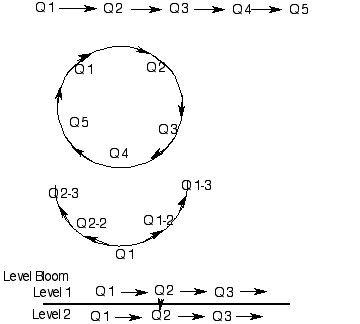
A circular pattern starts with a question (Q1) and is followed by four more questions, Q2, Q3, Q4, Q5; in this example, returns to the original question (Q1).
This pattern starts with a question (Q1 in the bottom center) and continues along two related tracks with different questions being asked for each track (might be a track - for and a track - against).
This pattern follows a parallel line of questioning with the same questions for two different ideas. Set of questions for book A and same set for book B. Same set of questions for Bloom's Level of analysis and the same set for synthesis.
Practice activities
- Raisins as Cartesian divers activity worksheet to practice wait time
- Plastic pop bottle and stopper Cartesian diver activity worksheet to practice wait time
- Jerry Spinelli questioning sequence in Smiles to Go - classroom discussion example to discuss questioning.