Card Tricks
When you have eliminated all which is impossible, then whatever remains, however improbable, must be the truth.
Card Tricks lesson plan sequence
Overview
Learners will observe card tricks, develop strategies to create the same results, explain why they believe their procedure is accurate, prove that their procedure will obtain the same results for all possible combinations and communicate their reasoning and results in a convincing manner.
Focus Questions
- How do magicians create a trick?
- Does mathematics have something to do with magic?
- Is there magic?
- How do you solve problems?
- Do you want to learn some card tricks?
Dimensions and Concepts
Problem solving
- Problems can be represented with drawings.
- Problems can be solved with trial and error, process of identification and process of elimination.
- Solving smaller problems can help solve larger problems.
Reasoning and proof
- Reasoning can help us solve problems.
- Prove a procedure will work for all possible combinations.
- Determine all possible combinations for arrays of cards.
Representation
- Cards can be represented in different arrays and their movement can be tracked individually or in groups
Algebra and patterns
- Patterns can be extended.
- Information that is scaled maintains its value and proportions.
- Multiples and factors
Geometry
- Properties of squares and rectangles.
Activity Sequence
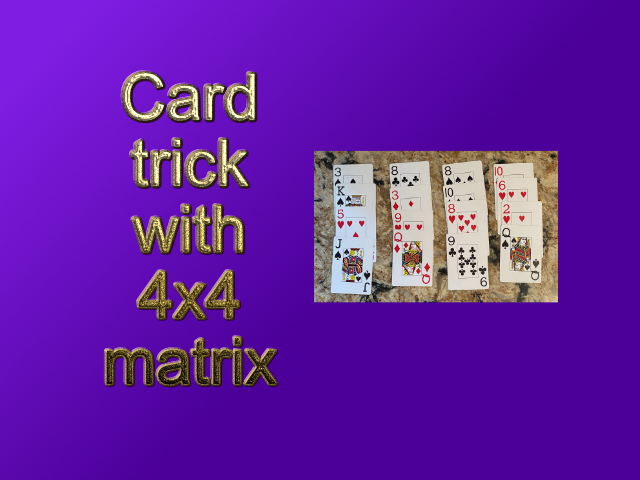
- Demonstrate card trick for 4 X 4 array
- Challenge students to reproduce trick
- Challenge students to prove that their trick will work for each placement of a card in the array. Ask the students what strategies they used.
- Ask the students to prove or disprove that any combination of arrays will or will not work. May want to stick to squares and then do rectangles depending on the students' background.
- Have the students share their results
- See if they can make a statement about the possibility of doing the trick by dealing the cards only twice. Create a rule for square arrays. When they agree that only squares can be done, challenge them to try to find a pattern for rectangles.
- Have them share their findings. At an appropriate time divide their findings into taller and wider rectangles and see if they can make a rule for each.
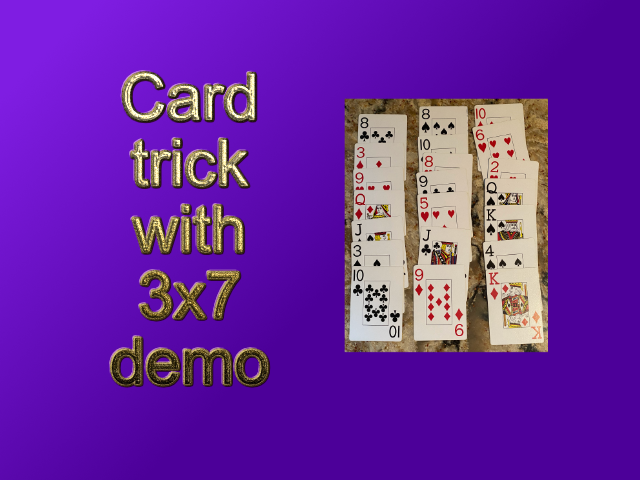
- When students are satisfied with their rule challenge them with the trick of 3 X 7 putting the cards in the middle.
- Challenge them to prove or disprove that the trick will work for every card in the array.
- Review what learned. Problem solving, process of elimination or identification, use of diagrams and symbols to help solve problems…
Activity Procedure
Before
- Ask the students if they want to learn how to do card tricks?
- Tell them that is what you are going to teach them and you want them to try and figure out why the trick works.
- Have the students move so that all can see what you are doing.
- Ask them to watch closely to see what you are doing so they will be able to figure it out.
- Deal three cards in a row face up, then three more cards in a second row also face up, and finally deal three more cards in a third row face up (4 x 4 array). Have the cards overlapping in each column so that each card can be identified and so you can pick each column up quickly.
- Ask a student to pick a card from the array and memorize it but don't tell it to anyone. Then ask him or her to tell you which column it is in. Pick up each column so that the column the student select is placed on the top of your pile face down.
- Deal the cards again so that the last three cards you picked up are on top of the deck and will be dealt into the top row. Continue to deal the cards until you have an array the same as the last time only the cards are rearranged.
- Again ask the same student to tell you what column the secret card is in.
- Pick up the cards again so that the column the student selected is on top.
- Pretend like you are not sure if the trick will work and tell them that when you slap the deck the magic card will come to the top. Slap the deck and turn the top card over.
During
Do and Prove the 3x3 card trick
- Challenge the students to do the trick.
- Put them in pairs and give each pair at least nine cards.
- Give them time to work through the problem. If students appear to be stumped you could repeat the trick. Avoid hints. Eventually a student should come up with an idea that can be shared with the other students and move them along.
- When students have an idea that they think works challenge them to prove that it will work no matter what card the audience member selects.
- Give the students time to prepare their arguments and then have them share with the class.
Still During
- Ask the students to explain how they are convinced that their procedure will work for all the cards.
- Have each share their ideas until all that are different have been shared.
- Ask them what problem solving strategies they used. Ask them if they used trial and error. For what and when. Ask the what other process they used to prove that all cards could be accounted for and that no matter what card was picked they would be able to identify it. If they can’t tell you the name of the process but describe it, then give them the name process of elimination or identification. Ask them why that name is appropriate of not.
- Ask them how they communicated their strategy. Did they use an array and show where each card was over time? If not show them how they could record their procedure in this manner
After or Connections
- Challenge them to predict if their rule/procedure would work for other squares. (Activity Squares)
- Have them try it out and prove it if they can.
- If they are sure it will ask them questions such as how many deals would it take if you had a 10X10 array, 100X100, Million X million.
- If you are sure they understand the square challenge them with rectangles. (Activity rectangles) Ask if their rule would work for rectangles. If so, would it work for all rectangles. Challenge them to find a rule or rules that would work for rectangles (wide rectangles and tall rectangles). If not how would they have to be different?
- When students feel pretty confident about how to make their trick work by putting their cards on top, ask them if they could make it more difficult for the audience to guess what they were doing if they buried the selected row in the middle of a rectangle/deck.
Scoring guides
Need to add scoring guides with outcome levels...