6rd Grade Tree Rings - Life Science - growth and environmental effects; Inquiry Process - observation, evidence, and reasoning to understand
Overview
Science content focus - what science says - enduring understanding, big ideas, generalizations
Science inquiry focus - how we use science to collect information to understand
Activity sequence
Resources and materials
Pedagogical ideas
Lessons and activities detail
Assessment
Overview
Students observe different slices of trees, photos, and diagrams of tree rings to organize observational information as it relates to changes in tree growth as a result of weather and other environmental factors.

Life Science - Living, growth related to environmental factors
(what science says - enduring understanding, big ideas, generalizations)
Animals consume energy and plants use sunlight to make their food. All living organisms use food for energy (metabolize), move, respire, use water, reproduce, respond to the environment (sensitivity), grow, excrete waste, require nutrition, and shelter. The quality of life, health of an organism depends on kinds of and amounts of environmental factors for the organisms that live there.
Related concepts and facts -
- Living organism change and grow.
- Organisms can survive only in environments in which their needs can be met (animals need air, water, food, and shelter; plants need air, water, light, nutrients, and shelter)
- One ring per year, with the outer most ring telling the current growth story
- The only living part is in the outer ring
- Generally the larger the ring the better the climate conditions (sun, rain, temperature, wind) and other environmental factors (insects, disease, fire, lightning, humans)
- Smaller rings or abnormally shaped rings shows negative effects from: animals, disease, insects, fungi, fires, weather: flood, drought, lightening, wind, hail, tornadoes, erosion, ice, frost...
- Different environments provide different kinds of and amounts of environmental factors for the organisms that live there. One ring per year, with the outer most ring telling the current growth story
Outcome - Living, growth related to environmental factors
Describe how the basic needs of an organism being met or not meet can be observed in how the organism grows.
Specific outcomes -
- Describe a tree as living and changing as a result of its interactions with its environment.
- Describe tree rings as observable result of a tree's needs being met or not met.
Inquiry - processes - constancy, change, measurement - variables relate to observable changes
Changes are observed and attributed to changes of other variables as the cause or having an effect on the observed change.
Related concepts and facts -
- Observed changes can be described as changes of properties (variables).
- Variables are observations of a property that changes - size, shape, temperature, amount, volume, rate, ...
- When people disagree on an observation, they usually make more and better observations.
- Observation, creativity, and logical argument are used to explain how variable changes effect resulting observations.
Outcome - Inquiry - processes - constancy, change, measurement - variables relate to observable changes
Describe change as a result of interactions. Describe those interactions as changes of a characteristic/ property (variable) that interacts with the object that changes.
Specific outcomes -
- Describe changes as a result of interactions (weather interacts with trees to change tree ring shapes).
- Describe interactions as changes of a characteristic/ property (variables) [(weather, climate, fire, animal, ...)] that interacts with the object [(tree)] that changes [(change the shape of the tree rings)].
Inquiry - processes - evidence, models, explanation
Science or a scientist uses observable evidence to create an explanation.
Related concepts and facts -
- Observed changes can be explained as being caused by changes of variables (changes of properties/ characteristics).
- Explanations are based on observations.
- Evidence is observation.
- Inference is an explanation based on observation.
- When people disagree on explanations, they can make more observations or change their explanation.
Outcome - Inquiry - processes - evidence, models, explanation
Make observations of change, identify variables associated with the change, and create explanations of how the variables effect those changes.
Specific outcomes -
- Identify variables related to a change (that that effect tree ring growth).
- Relate variables to change with an explanation.
- Tree rings are evidence that can be used toexplain (infer) the history of the tree's interactions with the environment over time.
Activities
to provide sufficient opportunities for students to attain the targeted outcomes.
Possible Activity Sequence
- Ask what effects different rates of tree growth and how those effects might be observed.
- Observe different tree slices and their rings. Discuss how the rings are a record of a tree's history. Discuss what variables might create differences in rings and discuss what different shapes of rings might represent
- Discuss trees in the neighborhood, visit, take photographs...
- View pictures of tree rings ...
- Can a twig's age be determined with observation?
Pedagogical ideas
Focus questions - What is living? How does living organisms effected by the environment
Exploration
Activity 1
Materials: tree trunk slices from different trees and different slices from the same tree, magnifying glasses, rulers, weather records,
What are tree rings? Do all plants have rings? What can we learn from the rings? What do they represent? How are tree rings made? Are they different and if so, why? (Exploration)
What characteristics of trees can be used to represent growth?
What variables could cause a tree to grow differently and how would it effect the growth?
Create a list of variables that might affect tree growth, describe the effect it might have, and how it might be observed.
| Variables that affect tree growth | How could the variable help the tree grow better or negatively affect growth? | What evidence might there be in a growth ring? |
| 1 | ||
| 2 | ||
| 3 | ||
| 4 | ||
| 5 | ||
| 6 |
Activity 2
Ask student if they can think of what evidence might be available to know how these different variables affected the tree?
Do you think there is evidence that could be used to know the history of how a tree grew over the years it was alive?
Show students a cross-section of a tree.
Discuss how the irregularities might match different events.
Pass out tree cross-sections so students can observe similarities and differences among them.
Identify different parts of the tree and label - heartwood, sapwood, annual growth rings, smallest growth ring, largest growth ring, infer most rapid growth ring, infer slowest ring, and infer environmental effects.
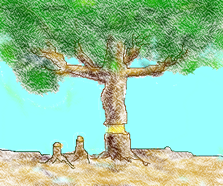
Story of girdling trees.
The forest was ideal for farming because it had the best soil. That meant it had to be cleared. Men and women cleared the land. A common method was to clear the undergrowth with a scythe, cut down all trees that had a diameter of eighteen inches or less, and kill larger trees by girdling them with an ax. Once they were killed the leaves wouldn't block the sun and they wouldn't use water or other nutrients, leaving them for the crops that would be planted among the skeletons. Later the dead trees could be burnt or left to rot.
Determine average ring width (measure or other...?).
Use a limb that has been cut into several pieces and challenge students to put it in order as it was before it was cut.
Are there differences in trees that can be found in the same location? And if so why?
Make a two classification system that describes at least two kinds of growing years - good and not good.
Activity 3
Have students talk about differences of trees around their home, school, park, or other areas.
Activity 4
Find an use pictures of different tree cross-sections to show how the life of the tree has created different growth rings and is a history of the environmental influences on the tree during its life.
Activity 5
Have students observe twigs and discuss how to determine how old each is. (look for annual growth rings and discuss how this observation could suggest how specific environmental factors varied to result in the observations.)
Lab Notes
Select felt.
| Material | Prediction | Observation | Comments |
| 1 | |||
| 2 | |||
| 3 | |||
| 4 | |||
| 5 | |||
| 6 |
- What?
Tree slice
Dr. Robert Sweetland's Notes ©
