
Topology, Networks, & Graph Theory exploration
Two-dimensional geometric networks & graph theory
Questioning is the foundation of all learning.
The first step in rejecting not knowing is to ask, why?
Sweetland
Introduction
Overview
- Introduction
- Review of networks, graph theory and topology
- What's my path?
- Do I have a continuous path?
- Exploration of graphs - four activities with worksheets
- Königsberg Bridges Problem
This article explores two-dimensional networks. It includes some introductory worksheets that explore paths and continuous paths. Then it has a sequence of graphs to explore graphs and develop properties of graphs in graph theory. It also has numerous examples for the relationship of networks, graphs, and topology. Bringing these ideas together is the story of how Leonhard Euler, of Switzerland, in 1735 uses graph theory to determine a solution of the Königsberg bridges problem.
Use any of the worksheets alone as puzzles or as as set of introductory activities to explore graphs in graph theory.
While the focus is on graphs and some of their properties I have included descriptions of networks, graphs and topology and their relationships that are appropriate for middle level learners to explore.
Review of networks, graph theory and topology
Networks, graph theory, and topology fit together simultaneously. For example consider a Subway Analogy.
Subway analogy
The Network is the physical reality. The steel tracks, the concrete platforms, the electricity, and the trains running on schedules.
The Graph Theory is the mathematical analysis of the system. It calculates how many stops it takes to get from Station A to Station B, or identifies which station is the most critical bottleneck.
The Topology is a simplified subway map. The lines are straightened, the curves are removed, and distances are not to scale. Yet the map is usable because the topological connections that connect the stations are 100% true or real.
Let's consider each
Topology
Topology is a branch of mathematical science that studies real world networks and graph theory. It is the, overarching branch of geometry that considers spatial relationships and connectivity that do not change when shapes are stretched, twisted, or crumpled. Like connected lines on a sheet of paper are still connected when crumpled into a ball.
Networks
Networks are real-world systems. The concrete, real-world application. They consists of physical or virtual entities that interact with one another. they have a specific job, a specific location, and specific data flowing through them. Examples:
- Social Networks: People connected by friendships, families, professional relationships, or social media.
- Internet and Computer Networks: Devices like computers and servers connected by cables or Wi-Fi to share data. Thinking about computer networks as abstractions let computers analyze connectivity, adjacency, and routing without relying on exact physical dimensions.
- Biological Networks: Neurons in a brain or food webs showing how energy flows between species.
- Transportation Networks: The US interstate highway system, and other transportation connecting cities by roads, rail lines, or flight paths.
Graph Theory
Graph Theory is the specialized branch of mathematics and a specific subset of topology (combinatorial or graph topology) used to model and analyze networks.
It removes the real-world variables (like how wide a road is or what a server is made of) and models the network in a graph made of vertices (nodes) and edges (links).
Graph Theory includes formulas, algorithms, and vocabulary to solve network problems. Example: To find the shortest delivery route through a city network, you can use a graph theory algorithm (like Dijkstra's Algorithm).
Graph theory defines the fundamental rules of connectivity, adjacency, and containment. It includes what is mathematically possible in a structure, regardless of scale or distance.
It takes networks, a collection of interconnected points or objects, that share information, resources, or pathways. In any network, the individual items are called nodes (or vertices), and the connections between them are called links (or edges).
Therefore, when you study abstract shapes, paths, and connections, the representation is a graph..
When you study data flow, social connections, or transit routes the representation is a network.
Graph properties
Eulerian network is a network that can be traced if you can begin at a node vertex and draw the entire graph without lifting up your pencil or going over an edge twice.
Application - A full trace will result in two outcomes: a complete circuit (start and stop at the same node) or path (start and stop at different nodes).
A Euler Path is a path that goes through every edge of a graph exactly once. It has a distinct start and finish. A drawing where you start at one of the node/vertex and finish at another. (like the house).
Application- A Euler Path requires you to count and cross every single individual edge exactly once.
A Euler Circuit is a Euler path that begins and ends at the same node/vertex. A continuous loop. (A figure-8 where every node has an even number of intersecting lines).
Application- A graph has a Euler Circuit only if every single node/vertex has an even number of connected edges.
Algorithmic:
Determining a Euler path relies on precise algorithms (like Fleury's or Hierholzer's algorithm) to track and calculate the sequence of steps. Because this relies heavily on discrete components (nodes/vertices and edges) and specific numeric rules, it is the definition of a graph theory problem.
Dijkstra's Algorithm is a famous graph search algorithm that finds the shortest path from a single source node to all other nodes in a weighted graph.
Application example a computer will calculate all the distances from a starting point to all the delivery locations (nodes) and find the shortest. Then it will eliminate it from the list of destinations and begin the process again finding the next shortest distance to the remaining destinations. When it finds it, it will again eliminate that destination and find the shortest distance to a destination on the list. Then repeating the process until all the remaining locations have been mapped.
The Historical Connection of Graph Theory to Topology
Even though these concepts belong to graph theory today, they were actually the beginnings of the field of topology. In 1736, mathematician Leonhard Euler solved a famous puzzle called the Seven Bridges of Königsberg. The townspeople wanted to know if they could walk through the city crossing all seven of its bridges exactly once without backtracking.
Euler realized that the physical size of the islands, the length of the bridges, and the actual distances didn't matter at all. The only thing that mattered was how the landmasses were connected. By stripping away the physical distances and focusing purely on the structural connections, Euler solved the puzzle (proving it was impossible).
This exact shift in thinking, ignoring physical measurements to focus solely on connections, is what laid the foundation for Topology
One last example
Topography
Topography is a physical science. It is the study and mapping of the Earth's surface features, shapes, and elevations (like mountains, valleys, and rivers). In topography, graph theory and networks work together by turning physical landscapes into mathematical models to analyze layouts and connections.
Geographical features in networks:
Nodes represent locations like intersections or river sources, and edges represent connecting paths like roads or streams meet or branch. Like geographic features (cities, stream junctions, routers) these features become points in mathematical networks.
Edges and Links are lines like physical pathways (highways, rivers, cables) they become lines connecting those points in mathematical networks.
Connectivity and Adjacency can be described by graph rules that define which locations touch or link directly, maintaining spatial relationships even if a map is stretched or distorted.
Summary
Topography provides the real-world physical data (the land). Topology provides the structural rules and math needed to analyze how things on that land connect and interact (the network).
Instructional notes - What's my path?
The first worksheet: What's my path?
Is to explore continuous paths.
Continuous path is drawn without retracing any part of it. Application - Draw the entire graph without lifting up your pencil or going over an edge twice.
It introduces nine graphs that have a path that can be traced with a continuous path without retracing any part of it (Eulerian).
Sample explanations using graph properties.
- Egg, star, spiral, and heart. They are one continuous path without nodes.
- Five-point star drawn inside a circle actually creates five vertices that each have exactly 4 lines touching them (2 from the star points and 2 from the circle segments). Because every single node has an even number of lines, it can absolutely be drawn in one continuous stroke.
- Others have one or two three node (odd) intersections.
- Stars in circles and spiral in pentagon have four node intersections.
- Egg, star, star in circle, and heart start and stop at the same place. All the rest start and stop at different places.
What's my path?
Find a path, draw it, and mark a start and finish.

Instructional notes - Do I have a continuous path?
The worksheet: Do I have a continuous path?
Is to explore paths that are continuous and not continuous.
- Continuous - a path drawn without lifting a pencil and without retracing any part of it.
Identify properties used to describe graphs. And begin to understand and explain how nodes (how many lines touch a point) determine if a graph is, continuous or not.
Answer key
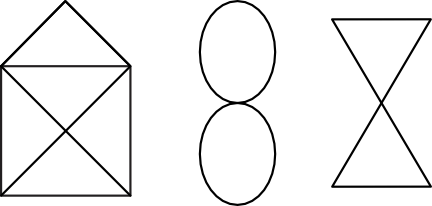
These three graphs are traceable, they have exactly zero or two nodes with an odd number of lines. If it has more than two odd nodes, it is impossible to trace in one go!
- The Classic Envelope House: A square with an X inside and a triangle roof. It has exactly two odd nodes (can you find them?) and the rest have four). You can trace it completely, but you must start at one odd node corner and finish at the other odd node. Different start and end points.
- The Infinity Loop (Figure-8): Two loops joined at a single central node. The central node has 4 lines touching it, and the outer loops are continuous. Because every single node has an even number of lines (4, 2, and 2), it contains a Euler Circuit. You can start anywhere and you will always finish exactly where you start.
- The Double-Triangle Hourglass: Two triangles stacked vertically, meeting at a single center vertex. The center vertex has 4 lines connecting to it, while the outer four corners each have exactly 2 lines. Since all vertices are even, it is perfectly traceable in one continuous loop. Start and stop at the same node.
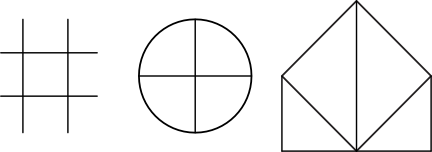
These three graphs are not traceable in one continuous stroke without retracing a previous traveled line.
The Tic-Tac-Toe Grid: Four intersecting lines forming a central square and open outer edges. The four internal intersections each have 4 lines, but because of the outer 8 loose end points you cannot draw a full tic-tac-toe board in one continuous stroke without retracing a previous traveled line.
Circle with a plus symbol inside. There are four nodes with 3 lines intersecting. More than two odd intersections seems to make it impossible.
The four triangles is a graph similar to The Seven Bridges of Königsberg. Three of the nodes have 3 lines touching them, and one node has 5 lines (the central island). Because it has four odd nodes (3, 3, 3, and 5), it is mathematically impossible to trace without retracing a line or lifting your pencil.
Do I have a continuous path?
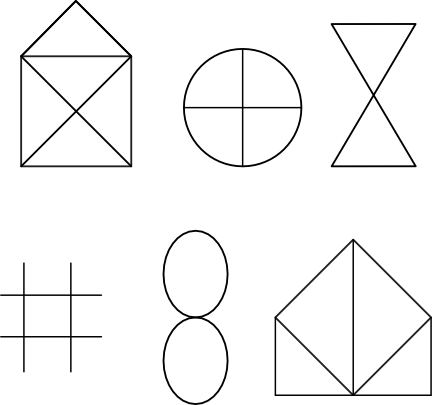
Find which of the graphs have a path that can be traced continuously (Eulerian) and which do not have a path that can be traced continuously (Non-Eulerian).
Continuous - a path drawn without lifting a pencil and without retracing any part of it.
Mark where you start and finish and if it isn't possible, identify what you think is the problem area.
Instructional notes - Exploration of graphs
The next set of worksheets are to explore graphs and systematically identify graph properties that describe their paths as continuous or not.
- Exploration 1
- Exploration 2
- Exploration 3 - Let's analyze networks!
- Exploration 4 -
Exploration 1 answer key
The box with the x in it. It cannot be traced without retracing a path. The two top corners each have 3 lines touching them (2 for the square edges, 1 for the diagonal). The two bottom corners also each have 3 lines touching them (1 side wall, 2 diagonals crossing). Because all four corners are odd nodes (degree 3), you will always get stuck and leave at least one line blank.
Exploration 2
Yes, No, Yes
Yes Yes No
Exploration 3
Complete the chart with new graphs or use any of the previous that may interest the learners.
Encourage noticing and sharing properties and any patterns or relationships discovered.
Exploration 4
Use ideas from the table and pick some graphs with common properties that might indicate a relationships or pattern.
Exploration 4 - Spoiler alert!
Summary
Zero odd vertices: The network can be traced and you will end up exactly where you started. This is called an Eulerian Circuit.
Exactly two odd vertices: The network can be successfully traced, but you must start at one odd vertex and end your tracing at the other.
More than two odd vertices: The network cannot be traced in a single continuous line.
Possible procedure with leading questions.
Use the data in the table to see how many ways the graphs that could be traced were traced. Identify them, write them below, and list their properties.
- What did you notice for those that can be traced continuously?
- What properties are common?
- What conclusions can be made?
Use the data in the table for the graphs that could be traced. Identify them, write them below, and list their properties.
- What did you notice for those that could not be traced continuously?
- What properties are common?
- What conclusions can be made?
Summary
- How can we determine if a network will have a path or circuit?
Consider networks/graphs that can be traced. Did you discover there are two types?
- Ones that can be completely traced back to the starting position in a single continuous line without lifting your pencil or retracing any edge.
- Ones that start and stop in different places.
- List properties for these two types.
- Start & stop same place.
- What properties are common for all of these?
- Start and stop different places.
- What properties are common for all of these?
Hints
Review the table for the following information.
- Count the nodes.
- Count the number of edges for each of the nodes.
- Count the number of lines (edges) connected to a specific node (point), These are called its degree.
- Consider networks with all even amounts of edges at their node?
Summary:
- What did you discover about graphs with Zero odd vertices? The network can be traced and you will end up exactly where you started. This is called an Eulerian Circuit.
- What did you discover about graphs with exactly two odd vertices? The network can be successfully traced, but you must start at one odd vertex and end your tracing at the other.
- What did you discover about graphs with more than two odd vertices? The network cannot be traced in a single continuous line.
Exploration of networks - 1
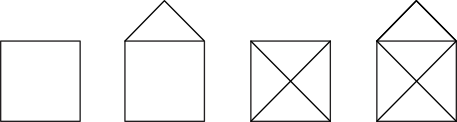
Which of these networks can be traced without lifting a pen or finger or repeated trace of an edge?
Square - YES or NO?
House -
X box -
X box house -
Make a conjecture about what graphs might be traced, without lifting a pencil, and which might not be?
More exploration - 2
How about these networks?
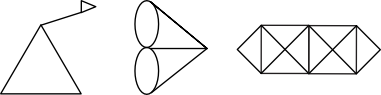
Notes:
Three more.

Notes:
Create some of your own!
Let's analyze networks! -3
Can we determine which can or can't be traced without tracing them?
Is there pattern?
Let's collect data and look for a pattern.
Vocabulary
- Node or vertices are represented as points where lines end or meet/ intersect.
- Edge or link is a connection between nodes.
| Graph/Network | Edges | Nodes | Nodes with 1 edge |
Nodes with 2 edges |
Nodes with 3 edges |
Number even edge nodes |
Number odd edge nodes |
Type of path |
 |
5 | 4 | 0 | 2 | 2 | 2 | 2 | Continuous start stop |
 |
7 | 5 | 0 | 3 | 2 | 2 | 3 | |
|
||||||||
|
||||||||
|
||||||||
|
||||||||
|
||||||||
|
||||||||
|
||||||||
|
Hint:
Whether it can be traced depends entirely on the connectivity of its nodes and the number of edges (lines) meeting at the points (nodes).
Let's dig a little deeper - 4 ....
Use the data in the table to see how many ways the graphs that could be traced were traced. Identify them, write them below, and list their properties.
Hints
Review the table for the following information.
- Count the nodes.
- Count the number of edges for each of the nodes.
- Count the number of lines (edges) connected to a specific node (point), These are called its degree.
- Consider networks with all even amounts of edges at their node?
What did you notice for those that can be traced continuously?
What properties are common?
What conclusions can be made?
Use the data in the table for the graphs that could be traced. Identify them, write them below, and list their properties.
What did you notice for those that could not be traced continuously?
What properties are common?
What conclusions can be made?
Summary
How can we determine if a network will have a path or circuit?
Consider networks/graphs that can be traced. Did you discover there are two types?
- Ones that can be completely traced back to the starting position in a single continuous line without lifting your pencil or retracing any edge.
- Ones that start and stop in different places.
List properties for these two types.
Start & stop same place.
What properties are common for all of these?
Start and stop different places.
What properties are common for all of these?
Summary:
What did you discover about graphs with Zero odd vertices? T
What did you discover about graphs with exactly two odd vertices?
What did you discover about graphs with more than two odd vertices?
Königsberg Bridges Problem
The Seven Bridges of Königsberg: The historical puzzle that started it all. It consists of four main landmass nodes connected by seven bridge edges. When mapped out, three of the nodes have 3 lines touching them, and the central island node has 5 lines. Because it has four odd nodes (3, 3, 3, and 5), it is mathematically impossible to trace without retracing a line or lifting your pencil.
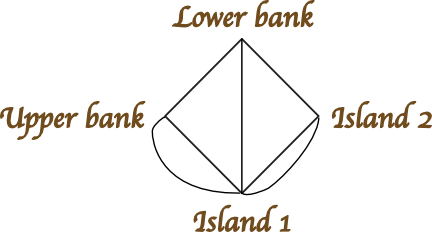
Check out the Königsberg Bridge Problem and see if you can explain it with a Euler Path & Circuit.
The Network: The actual physical city of Königsberg, its landmasses, and its stone bridges.
The Graph Theory: Turning those landmasses into nodes and the bridges into edges to count their degrees.
The Topology: Stripping away the physical sizes and shapes of the islands to look only at how they connect.
The Königsberg bridges problem
Background
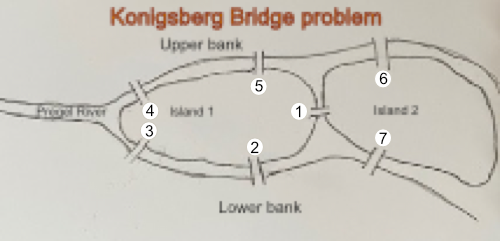
The Königsberg bridges problem originates in the city of Königsberg, Prussia (now Kaliningrad, Russia). This city was built on the banks and islands of the Pregel (Pregolya) River.
The map shows how the seven bridges are situated on an upper bank, lower bank, Island 1, & Island 2.
Problem
As the residents of Königsberg travel around their city, a curious question is poised:
Is it possible to take a route that crosses each bridge only once? And if so, how?
Hints:
- Try a guess and check strategy.
- Use diagrams to show different path variations of bridge passage.
- Discover that an odd number of bridges in combination with the two island seems to always traps you without another bridge to cross to get to a remaining bridge.
- Systematically start at each bridge to eliminate starting points that won't work.
- Consider Graph Theory
1735 Leonhard Euler, of Switzerland, uses graph theory to determine a solution of the Königsberg bridge problem.