Classification
Activity One: Red & yellow squares, triangles, & circles

Materials
Envelope with 12 shapes: small yellow square ,small yellow circle, small yellow triangle, small red square, small red circle, small red triangle, large yellow square, large yellow circle, large yellow triangle, large red square,large red circle, and large red triangle.
Each group has 12 pieces of paper.
Divide the papers into two groups. What characteristic did you use to divide them?
1.
2.
Put your papers back into one group. Divide them into three. What were the three characteristics used to separate them?
1.
2.
3.
Put your papers back into one group. Divide them into six groups. What are the characteristics used to separate them?
1.
2.
3.
4.
5.
6.
If you would make a graph for the data it might look like the following:
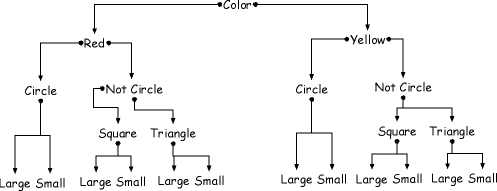
Write the name of each unique object below the end of the path that identifies it.
You identified 12 objects. Another way to represent this is with a dichotomous key.
Below is a dichotomous key for this set of objects. It divides the objects into pairs, the first pair is red and yellow (1A and 1B). Depending on the color of the object to identify the next number is chosen from the one that describes the object (2 or 7). Continue the procedure until the object is identified.
Use a large red circle and key it out on the key:
| Red - yellow circle, triangle, square key |
|---|
| 1 A - Red paper (2) |
| 1B - Yellow paper (7) |
| 2A - Circle (3) |
| 2B - Non circle (4) |
| 3A - Large red circle |
| 3B - Small red circle |
| 4A - Square (5) |
| 4B - Triangle (6) |
| 5A - Large red square |
| 5B - Small red square |
| 6A - Large red triangle |
| 6B - Small red triangle |
| 7A - Circle (8) |
| 7B - Non circle (9) |
| 8A - Large yellow circle |
| 8B - Small yellow circle |
| 9A - Square (10) |
| 9B - Triangle (11) |
| 10A - Large yellow square |
| 10B - Small yellow square |
| 11A - Large yellow triangle |
| 11B - Small yellow triangle |
Note that when something is keyed down, it is identified. It has been classified completely when you reach the italic maroon print.
Try to identify several pieces of paper on the key, such as a small yellow triangle, until you know how to use it easily.
Activity Two: What's the Object ?
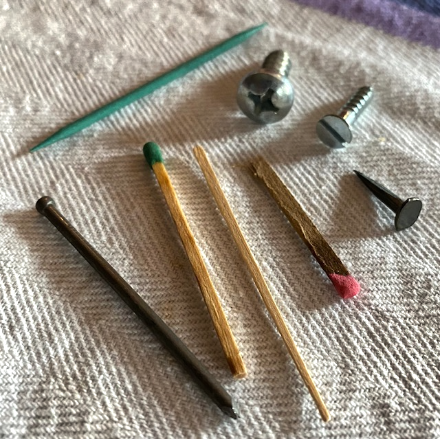
What's the Object ?
Materials
Envelope with 12 shapes: wooden match, paper match, pointy tooth pick, flat toothpick, finishing nail, tack, Phillips head screw, & slotted screw,
In the small container are a number of objects which can be graphed the same way as the bits of colored paper. Fill in the graph below:
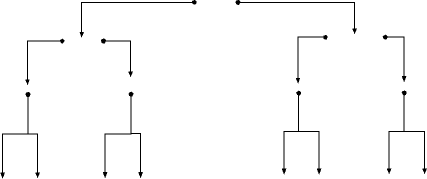
The objects can also be identified with a dichotomous key. Have a partner select one object from the container, without you seeing what it is, and ask your partner questions to identify the object.
| Assorted object key |
|---|
| 1A Object made of metal (2) |
| 1B Object not made of metal (5) |
| 2A Shaft mostly smooth (3) |
| 2B Shaft with deep grooves on it) (4) |
| 3A Two inches or longer - NAIL |
| 3B Less than two inches - BRAD OR TACK |
| 4A + on top - PHILLIPS SCREW |
| 4B One slit on top - SCREW |
| 5A Match (6) |
| 5B Toothpick (7) |
| 6A Wooden shaft - WOODEN MATCH |
| 6B Paper shaft - PAPER MATCH |
| 7A Round shaft pointed at both ends - ROUND TOOTHPICK |
| 7B Flat shaft pointed & rounded on opposite ends - FLAT TOOTHPICK |
Now key out a paper match.
Keys are useful in the identification of plants and animals. Your teacher can give you keys to identify: deciduous trees, evergreen trees, insects or other objects.
Activity Three: Making Your Own Key
To really understand a key you should make one for yourself. Try one for animals like: pigeon, rattlesnake, rabbit, goldfish, earthworm and butterfly.
First, you might want to record the similarities and differences
of the animals in a chart.
After you have collected enough data you can
make a graph. Here is one started for you.
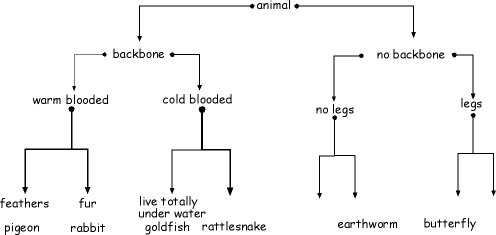
or a chart might help:
| pigeon | rattlesnake | rabbit | goldfish | worm | butterfly | |
|---|---|---|---|---|---|---|
| wings | ||||||
| scales | ||||||
| feathers | ||||||
| warm blooded | ||||||
| cold blooded | ||||||
| backbone | ||||||
| fur | ||||||
| live totally under water | ||||||
Now complete the dichotomous key:
| Animal key |
|---|
| 1A Animals without a backbone (2) |
| 1B Animals with a backbone |
| 2A With legs - BUTTERFLY |
| 2B Without legs - |
| 3A |
| 3B |
| 4A |
| 4B |
| 5A |
| 5B |
| 6A |
| 6B |
| 7A |
| 7B |
Now that you understand how to make a graph or a dichotomous key you can use them to help sort, classify, or identify objects.
See examples - leaf identification chart dichotomous leaf identification chart coniferous