Sound Activities

Activities collected from the teacher's resource file, Science and Children, and activity books.

Tuning Fork Activities:

Materials: Two tuning forks of different size and a beaker

Activity 1

  1. Hit the tuning fork against the bottom of your shoe
  2. Position it near your ear
  3. What do you observe?
  4. Hit the tuning fork again
  5. Touch it against your earlobe
  6. What happens?
  7. Fill the beaker 2/3 full with water
  8. Hit the tuning fork and touch its tips to the surface of the water
  9. What happens?
  10. What does the tuning fork do when it makes sound?

Activity 2

  1. Hit the tuning fork and hold it near your ear
  2. Count how long you can hear the sound
  3. Hold the open end of the beaker over your ear
  4. Hit the tuning fork and place the handle on the bottom of the beaker
  5. Observe
  6. How did the beaker effect the sound energy?
  7. Do the same type of experiment only place the handle of the tuning fork onto the top of a desk or table
  8. Observe
  9. How did the table effect the sound energy?
  10. Have students describe the above observations.

Activity 3

  1. Hit the large tuning fork and bring it close to your ear
  2. Observe.
  3. Now repeat the procedure with a smaller tuning fork
  4. Observe
  5. How do the different pitches compare
  6. What relationship do you think there is between mass and pitch?

Rubber Band Activities:

Materials: ruler, pencil, rubber bands of differing thickness, plastic or metal rectangular containers

Activity 1

  1. Stretch a rubber band and have someone on your team strum it
  2. Observe the pitch
  3. Repeat the activity only stretch the rubber band further
  4. Strum it again
  5. How does the tightness affect the pitch?

Activity 2

  1. Stretch a rubber band across a ruler
  2. Strum the rubber band
  3. Compare the pitch of the sound produced to that of a rubber band stretched the same length but strummed in the air
  4. What is the difference?

Activity 3

  1. Stretch the rubber band across a small container and strum
  2. Observe the sound
  3. Stretch a rubber band across a container that is the same except deeper
  4. Compare the sounds.

Activity 4

  1. Stretch two rubbers bands that are the same length and thickness, but different widths across a container.
  2. Strum one of the rubber bands
  3. How can you make it softer?
  4. How can you make it louder?
  5. Predict how the pitch of the wide one will compare to the pitch of the narrow one
  6. Try it
  7. What did you observe?

Activity 5

  1. Stretch two rubber bands of the same length and width but different thickness across a container
  2. Predict which rubber band will make the highest pitch
  3. Try it
  4. What did you discover?
  5. Put eight rubber bands across a container to make an eight note scale
  6. Make a push pin guitar

Pop Bottle or Test Tube Activities:

Materials: pop bottles, medicine droppers, pencil

  1. Blow across the mouth of an empty pop bottle
  2. What sound do you hear?
  3. What is happening to produce this sound?
  4. Add water to the bottle until it is 1/4 full
  5. Blow over the mouth
  6. What sound do you get now?
  7. Try different amounts of water
  8. How did the amount of water effect the pitch of the sound?
  9. Blow gently. Blow hard. What is the difference?
  10. Use eight bottles and use a medicine dropper to add water to produce notes of a musical scale.
  11. Pop bottle or test tube flute

Straw Activities:

Materials: straws and scissors

Activity 1

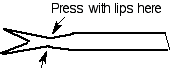
1. Take a plastic straw and flatten the end about two centimeters

2. Cut the two sides of the flattened portion so it looks like the drawing below

3. To play the straw instrument put the cut end into your mouth so that your teeth are pressing the straw on the top and bottom at a point just beyond where you cut and with both slits parallel with your teeth.

4. If you press your teeth together slightly and blow you should be able to get a buzzing sound.

Activity 2

        1. Make a second straw instrument and compare the sounds made by the two
        2. How does the size effect the pitch?
        3. How does blowing hard or soft effect the sound?
        4. Take one of the instruments and while blowing a steady sound cut off some of the length
        5. How does this effect the pitch?
        6. What relationship is there between the length of the air column and the pitch?
        7. Explain how this effect will change the pitch of a musical instrument
        8. Select a musical instrument and draw a picture of it below
        9. Show how the air flows through it to get different pitches
        10. Flute - tape several straws of different lengths together
        11. Straw oboe

Activity 3

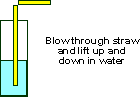
Water and air trombone - Cut a straw one inch from the top end about three-quarters of the way through. Bend and blow through the short end while you move the other end up and down in a glass of water. For an air trombone pinch different lengths of the straw.


Tube Kazoo Activity:

Materials: cardboard tube, rubber band, square piece of wax paper, pencil

  1. Stretch the wax paper tightly across one end of the tube and hold it in place with the rubber band
  2. Punch a small hole in the middle of the tube with a pencil
  3. Make a humming or "ooing" sound into the open end of the tube

Animal Quackers In A Can Activity:

Materials: Tin can with one end, paper clip, 50 cm piece of string, medium nail

  1. Use the nail to punch a small hole in the bottom center of the lid
  2. Thread the string through the hole and tie it securely to the paper clip
  3. Hold the can with one hand and use your thumb and forefinger on your other hand and hold the string tightly up near the can
  4. Slid your fingers along the string and the can should make an animal like sound

Stereophonic Hanger Gong Activity:

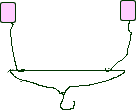
Materials: Two paper cups or plastic cups, two paper clips, two 50 cm pieces of string, and wire coat hanger

  1. Punch a small hole in the bottom center of each cup
  2. Fasten the string to the cups with the paper clip
  3. Tie the other end of the string to the coat hanger
  4. Hold the cups to your ears while you strike the hanger


 Hanger Gong Activity:

Materials: Coat hanger, spoons, and string

  1. Tie the spoons to the coat hanger with the string
  2. Hear and feel the vibrations from the spoons

Talking Balloons Activity:

  1. Materials: one balloon for each group
  2. Blow-up the balloon and hold it shut
  3. What do you hear? Nothing
  4. Squeeze the end of the balloon and listen
  5. What do you hear? Squeeeeeek
  6. What makes the squeeeeeeek?
  7. Our vocal cords analogy

Sound Chamber Activity:

Materials: Box or poster board to make a sound chamber.

  1. Sound chamber is a box or poster board in a cylinder shape with the bottom open to the table
  2. Objects are dropped in the chamber so a student can not see the object and then identifies the sound made by the object hitting the table
  3. Students can be use a sorting mat to sort identical objects in the order dropped
  4. After all the dropping is done the two students can compare their sorting mats

Pitch And Music Activity:

Students will move their body in response to pitch in music of a song

Students will illustrate a drawing in response to pitch in music of a song


Phone Conductors Activity:

Materials: Plastic cups, string, yarn, fish string, metal wire, paper clips, and a medium sized nail

  1. Use the nail to punch a hole in the bottom center of two cups
  2. Use the paper clip to fasten one end of the string to each end of the cup
  3. Talk on the phone
  4. Devise an experiment to test which of the materials makes a better phone

Dr. Robert Sweetland's Notes ©