Professional educator conceptual framework for their knowledge base
What Outstanding Teachers Know and Do
Observing outstanding teachers is - seeing artistry in action.
This page describes and explains a professional educator's conceptual framework. The knowledge base which informs it, its development, and their professional development through their reflection cycle to update and strength it. Information, which informs it includes: philosophies, theories, subject's knowledge, curriculums, planning, teaching, and more.
Professional educator conceptual framework
An outstanding teacher engages students in learning in a manner that develops desire and skill to be life long learners through communication within a variety of experiences in a caring manner that contributes to a variety of individual and community structures that respect and support life.
Every decision teachers make is based on their questioning (inquiry) and thinking (reflection) about what they know (knowledge base) how they see and know themselves as they are influenced and learn by their interactions and communications with the world.
How educators use their knowledge base to develop and make educational decisions is their conceptual framework.
Obviously, educator's decisions will be more beneficial to students when good information is used in ways that best inform their decisions.
One way teachers inform their decision making is to reflect and research on their own knowledge base by asking questions such as:
- What are the sources of my understandings? How do I know what I know?
- What might influence my decisions?
- How do I make good decisions?
- How does my knowledge relate to education? ... Conceptual framework.
Reflection on these questions provides information which is central to what teachers know and do and can provide categories for both a knowledge base and conceptual framework.
Possible categories might be: communication, mediation, teacher, student, pedagogy (teaching, learning, & facilitating learning), manage, learning for body, mind, self, and soul.
To outline or diagram a conceptual framework one needs to know more about each category and how they relate to education and teaching. To do this each can be unpacked for additional detail; and to show how they might be related, focus questions can be used to describe how educators relate these ideas in their practice of education. The result is a conceptual framework, which, if accurate will over time determine what we call education.
Professional educator's conceptutal framework visual
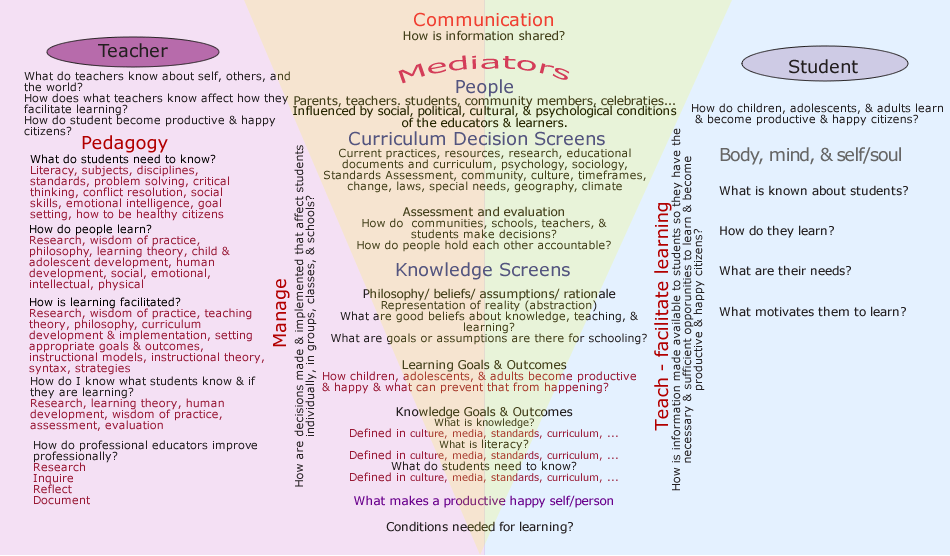
Professional educators make decisions based on their knowledge base and continually assess and evaluate them. The better their understanding of research and practice the more effective their teaching and the greater their student achievement.
While a conceptual framework is the mental structures teachers use to make decisions; curriculum designers often refer to conceptual frameworks as a document that identifies and describes information needed for best educational practices. As the name implies it doesn't suggest a complete structure, but a framework, like the iron work of a building or the wood framing of a house. Similarly a conceptual framework documents categories and suggests information for professional educators to use to make better decisions when they evaluate their practices through inquiry, reflection, and research.
Teacher's philosophies and beliefs combine with their understandings about the world, people, students, and learnings to create their conceptual framework. While a conceptual framework of education, curriculum, or teaching is a framework, other documents are created to provide detailed information to implement the ideas in a framework. Or to use the information in other documents to make or adjust a framework as our understanding becomes more comprehensive. Documents that attempt to answer the questions in the framework above and the topics and subtopics represented.
Below are examples of some of these documents:
Elements that inform & develop conceptual frameworks
Philosophy documents
A philosophy document is like a framework with its focus on beliefs about education. Why we educate, what education should achieve, how to educate, and generally everything about education. In one respect an educational philosophy focuses on the importance of education for human survival and the creation of a good life.
Explore ideas and suggestions to review or develop an educational philosophy.
As in the Donkey Fable, whether people are aware of their basis of decision making or not, they have a conceptual framework and philosophy they use to make decisions, they just may not know what it is. To make better decisions it is necessary to know and develop a comprehensive understanding of our conceptual framework and other details beyond a framework: curriculum, plans, policy, procedures, and more to make good decisions.
A comprehensive framework would include all the variables that affect how educational decisions are made. It would need to include information from the world, teachers, and students and how they all interact. The major mediator being communication.
Thus, when we have a conceptual framework and an educational philosophy to use to guide us and reflect on general educational decisions, then we can create other documents to guide our more specific decision making. For example to guide the subjects or disciplines we teach. One general document would be principled procedures for the subjects or disciplines we teach. Here are three examples:
Principled procedures for subject or disciplines
Principled procedures are general guides to make decisions and reflect on our decisions for a specific subject. Here are three examples to explore:
Outstanding teachers use principled procedures along with their comprehensive understanding of content, and students to guide their planning and to facilitate learning. However, like the Donkey Fable, they may not be developed and known well enough for them to make consistent decisions if they have not reflected on their practice and documented appropriate procedures and situations in which decisions to use them should be made so their student's academic achievement and their own personal professional development is optimal.
Also, educators who take the time to document what they want as their own principled procedure will find greater peace of mind when they make decisions. They are relatively short documents so the procedures can be well known and recalled to use as a decision screen when making decisions and reflecting on how the implementation of their decisions worked so they might use them in the future or suggest different decisions. The feeling of reviewing your principled procedure after a difficult decision and seeing that it was congruent with what you documented really provides a peaceful satisfaction.
Let's continue to focus this overview of documents in subjects.
Subject Knowledge
How to Know the Subjects We Teach
The more teachers know and understand, the better they facilitate students' learning. Since much of the information students learn in schools is categorized by subjects or disciplines, it is important to know the characteristics, dimensions, and content of the disciplines or subjects taught.
Most people with definitions.
So let's look at some subject or discipline defintions:
Definitions are interesting and can connect important ideas to the subject in a powerful emotional manner that provides unique insights into significant aspects of the subject. However, even the most comprehensive definition lacks sufficient information to inform teachers and students of what is needed to be learned to be literate in that subject.
Thus, definitions are insufficient to know what is necessary for students to learn to be literate.
To provide depth, various learned societies have brought together experts, who have written documents that describe information a person would need to know to be considered literate in different subjects. Information which has been collected and published in documents often called standard documents.
Subject Knowledge Organization
Their Common Categories or Dimensions
Before learned societies published standards, people still thought about the content a person needed to know in different disciplines, or subjects, to be literate and published their ideas, but didn't call them standards. A survey of these works and the organization of many different standards reveal four common categories or dimensions for all subjects.
This is helpful to know, particularly for elementary teachers who are experts in many subjects. Because, by knowing these four dimensions a person can use them for all subjects helps provide a comprehensive view of a subject to structure learner's experiences to fully develop their literacies. Let's review these:
Four dimensions or categories of a subject or discipline:
Discipline literacies start with a perspective of each discipline, which indicates the kinds of knowledge each discipline represents. Its knowledge base, which includes information in four dimensions.
- Processes or practices of the subject or discipline. The processes and the skills used to create knowledge in the subject. The how to inquire, investigate, mathematize, problem solve, observe, classify, make representations, reason, search for answers, communicate problems and answers, resolve conflicts opinions, comprehend, create, ...).
- Content knowledge or information created by the practice and processes of doing the subject or discipline. The what of the subject. The facts, ideas, stories, explanations, concepts, generalizations, principles, theorems, laws, actions, skills, processes, products, ... created.
- Attitudes or Dispositions or Habits of Mind or Values. The mental states people have when they practice or inquire and use the subject to learn about or understand the world in successful ways. Attitudes to have when doing the subject to create knowledge and products of the discipline. Examples or dispositions that are usually valued when doing or studying a subject or discipline include: curiosity, desire to understand, open-minded, skeptical, persistent, ... more examples.
- Perspectives of the discipline itself, its relationships and connections to society, culture, history, other disciplines and it can and can not be used in all of its respects.
Literacy in any subject or discipline must include substantial experiences for learners to develop information and skills in each of these areas for each and every subject or discipline.
The following charts illustrate how these four dimensions relate to categories in national standards:
Science:
- Common Core State Standards of Science, and the National Science Teacher's Association Standards and Project 2061 by content, procss, attitude, and perspectives
- National Science Teacher's Association Content Standards - categorized by content, process, disposition, and perspectives
- Project 2061 - categorized by content, process, disposition, and perspectives
Mathematics
- Mathematics NCTM standards categorized by content, process, attitudes, and perspectives
- Common Core State Standards of Mathematics by content, practices, attitudes, and perspectives
Literacy categories and more
Explore these models for examples of the four dimensions. Hint, they are included, but not labeled as in the previous examples.
Planning
Teaching
Summary
Outstanding teachers have a very comprehensive understanding in all these dimensions, or categories, for the subjects they teach. Knowing these dimensions helps teachers understand, remember, and more comprehensive opportunities for their students to understand and appreciate all dimensions of the subjects they study so they may participate as a scholars in those subjects and create knowledge and products with and for the discipline for their personal inquires, development, and satisfaction.
As you study different subjects think about the four dimensions to increase your understanding and power in using the subject you study and providing experiences for others to broaden their understandings.
Professional educators and their development
Professional educators develop or improve through their inquiry and reflection on their practices. Major ideas related to professional develop to consider are illustrated in this model:
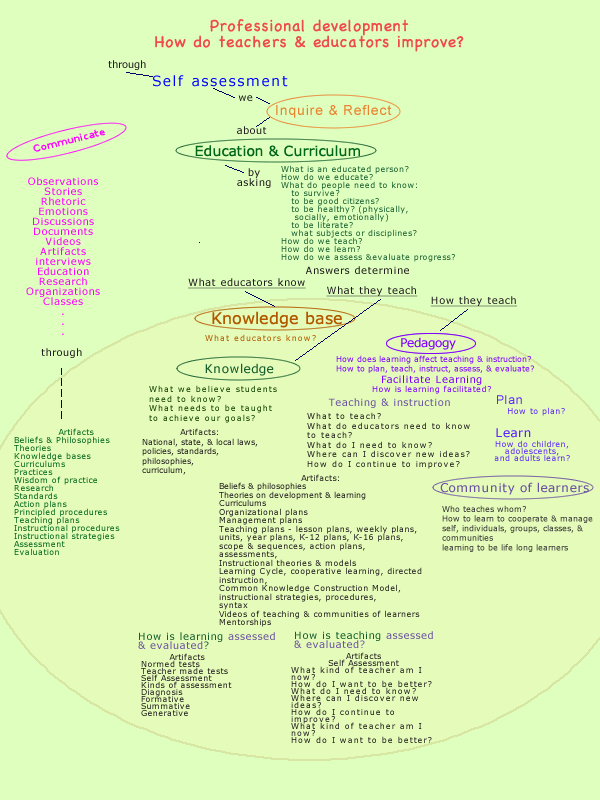
Professional development cycle
Professional educators use a learning cycle to develop through their inquiry and reflection of their practices. A model for this development is presented below along with focus questions and related artifacts:
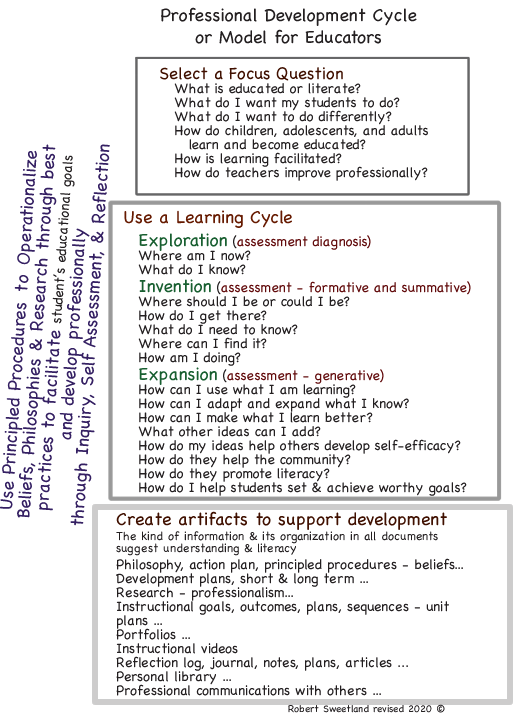
Professional development cycle applied to discipline
Professional educators use the same learning cycle and processes to inquire and reflect on their practices as they related to different subjects as illustrated by the model below.
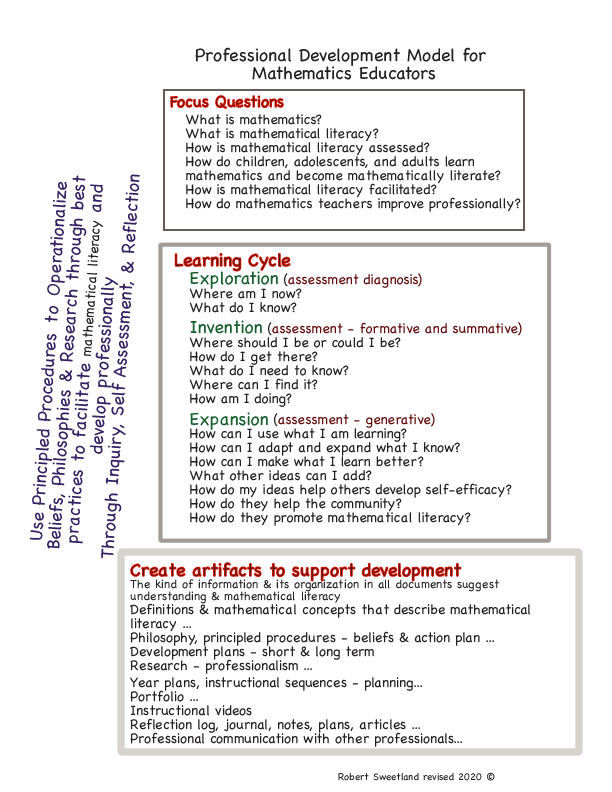 For more specific information on professional develop in subjects see:
- Walk through of professional development for mathematics.
- A walk through of professional development for science.
Home: Pedagogy - theory, curriculum, learning, human development, & teaching