Exploration of Myths & Legends
Using The White Stag by Kate Seredy to explore myths & legends
A myth is a lie that conveys a truth.
C. S. Lewis
Introduction
Overview
- Introduction
- Focus questions
- Responses to literature
- Application of literature, genre, and media as a narrative myth or legend
- Story elements and style appropriate for myth or legend genre
- Multimedia use
- Educator instructional, evaluation, and reflection considerations
- Presentation planning and scoring ideas / guide
- Presentation Scoring Guide
- Supporting information for possible integration of other learning outcomes
A multimedia unit or project focused on literature of myths and legends as an explanatory device. Explores The White Stag as a written example of a legend or myth.
Focus questions
- Why do people have a need to explain?
- In what forms are people's explanations? (Myths and legends - explain origins or cause and effect, science explains observations ... , math explains quantities ..., history explains ..., archeology ..., anthropology …)
- Are myths universal?
- Are legends universal?
Response to Literature
- Recognize thee are different responses to literature and people have different responses depending on their experiences.
- Recognize and interpret story elements and respond to text and illustrations by demonstrating how to:
- Paraphrase or summarize major events.
- Identify plot, setting, characterization, point of view, theme, style, and tone.
- Connect what has been read to prior knowledge, other texts, or the broader world of ideas.
- Identify, describe, or make logical predictions about character, setting, problem/solution, or plots/subplots, as appropriate to text; identifying any significant changes in character or setting over time; identifying rising action, climax, or falling action
- Identify the characteristics of a variety of types of text and genre (narrative, prose, poetry, plays, fairy tales, fantasy, fables, realistic fiction, folk tales, historical fiction, mysteries, science fiction, myths, legends, short stories, epics, dramas).
- Define quality attributes for story elements and genre and use them along with evidence to support their critically evaluation of a legend or myth by demonstrating how to:
- State and maintaining a focus (purpose), a firm judgment, or a point of view when responding to questions.
- Use specific details and references to text or to support inferences or judgments.
- Make inferences about the relationship(s) among content, events, characters, setting, plot, theme, style, tone, bias, point of view, or characteristics of other literary forms and genres.
Application of literature, genre, and media as a narrative myth or legend
Use literary Elements and Devices to tell a story
- Write a narrative that establishes settings,
- Creates a clear and coherent plot to maintain focus, control pace, and advance the story that uses a variety of effective transitional devices to enhance meaning, problem/conflict/ challenge, and resolution,
- Establishes characters and their motivation, through description, speech and actions, and relationships with other characters,
- Use style to establish a realistic tone for the piece with the use of imagery, descriptive details, sensory language, dialogue to advance action
- and
- Has a consistent point of view
Story elements and style appropriate for myth or legend genre
- Recognize and understand genre attributes as a myth or legend when listening or viewing literature.
- Use myth and legend genre attributes to create or retell a story as a myth or legend.
Multi Media
- Understand and critically analyze the use of media for telling stories.
- Use multimedia to create or retell a story
Materials - Myths, legends, myths & legends elements/ attributes, myth legend notes, video equipments, internet ...
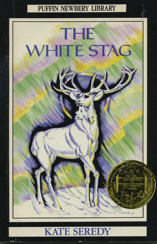
The White Stage
A 94 page illustrated epic told in the best traditions of Greek and Roman mythologies. The story unfolds the origins of a prophecy with all the trappings of gods and mortals, mystical creatures and fantastic animals all positioning to gain favor for their kind so they might have a better life. The quest for this better life for the Huns and Magyars leads to the rise of Atilla who leads them in a migration from Asia to Europe and into their promised land.
Instructional Ideas -
- Ask. What is a myth and legend?
What are the purposes of each? - Read myths and legends and create a description for the genre of myth and legend and identify what might be considered quality elements.
- Use The White Stag or other stories to study and describe how they might be a myth or legend and what attributes would need to change to make it definitely one or the other.
- Brainstorm ideas to create and share a multimedia presentation for their own or another myth or legend.
- Take an inventory of material needs and learner needs to determine what is needed to complete the presentation.
- Do they know how to use the art supplies, software, cameras, scanners, …
- Do we have access to the materials and equipment needed?
- Prepare for telling of myth or legend and create a multimedia presentation.
- Search for and select images and music to accompany the legend or myth.
- Work together to select items to be included on their scoring guide for evaluation of their presentation.
- Share their presentations with other groups and maybe publish it.
- Write about the process and what they learned.
Educator instructional, evaluation, and reflection considerations
- What did students know about mythology at the beginning of the lesson?
- How did you diagnose these ideas at the beginning of the lesson and what convinced you that your inferences were accurate?
- What processes and strategies did the students use?
- How did you focus students’ attention on these ideas?
- What did you learn that is important for other teachers to know?
- Describe different ways students represented there ideas.
- What did students learn?
- What did students do during the lesson to increase their understandings?
- How did you make the decisions that facilitated students' understandings of those idea(s)?
- How did you focus students’ attention on these ideas?
- What did students say or do to convince them and you that they understood the ideas(s)?
- What did the students say or do to convince them and you that they could apply or expand the idea(s)?
- What ways were you able to push students to try new ideas for any of the ten dimensions?
- What did the students say or do to convince themselves and you that they were doing quality work?
- How did you encouraged students to use attitudes that they found helpful when completing their project? What did the students say or do to convince themselves and you that they valued and/or enjoyed it?
- How did you create opportunities where students had a desire to communicate with or work with other students?
- How did you increase students understanding of what communication is, how it can be used, and a desire to use and value its use in their world?
- What did you learn that is important for other teachers to know?
Presentation planning and scoring ideas
Brainstorming, Planning Sheet, and Summary Sheet
Resources:
I used these resources ... which were this media ... because ...
I think the media supports these ideas in these ways ...
The media fits with each other media in these ways ...
I cited the source of the media and used it appropriately.
I felt the resources used were reliable and credible because ...
Text is appropriate, readable, spelled correctly, displayed appropriately,
Background, and other elements have patterns, color, lines, textures … support this in these ways ...
Transitions seem to go together and move from one to the next in this way ...
Sounds and music are easy to hear and create understanding for the audience.
My presentation was clear in these ways
Describe how each of the following were used or considered in your production:
- Setting(s)
- Characterization
- Plot
- Point of view
- Theme
- Style
- Tone
Describe what genre you consider your piece to be and your rationale and evidence for it.
Describe what makes it quality literature.
Presentation Scoring Guide
| Category | Upper level | ... | ... | Lower level |
|---|---|---|---|---|
| Use of story elements | All story elements are considered and used appropriately in a supportive comprehensive and creative telling of the story. | All story elements are considered and used appropriately in a supportive comprehensive telling of the story | All story elements are used appropriately. | |
| Representation of ___ genre | The story is an ideal representation of the genre. | Misrepresentation of the genre. | ||
| Pacing | Story is told with inflection and change of pace that created suspense and corresponded with the plot and action. | Story is usually told with inflection and appealing pace, but one or two parts seem to drag or to be rushed. | Story is at times told with inflection and pace changes, but at times seems to drag or be rushed. | Story is told in a monotone and at one pace. Does not change the pace to match the story. |
| Voice | Speaks with appropriate volume, pace and clarity so all audience members can understand all the time. | Speaks with appropriate volume, pace and clarity so all audience members can understand most of the time. | Sometimes the volume, pace, or clarity is too mumbled or emphatic, fast or slow, or garbled so the audience sometimes has trouble understanding. | Speaks too softly, mumbles or talks too quickly so that the audience often has trouble understanding. |
| Duration | Appropriate length. Didn’t rush or continue beyond what was necessary in the stories telling. | One or two places where more or less time would have been beneficial to communicate an idea being spoken, written, displayed or other. | Three or four places where more or less time would have been beneficial to communicate idea being spoken, written, displayed or other. | Many places where more or less time would have been beneficial to communicate an idea being spoken, written, displayed or other. |
| Media | Media represent and support well the ideas, theme, style, and desired tone. | Media is related to the narration, but some are window dressings and not supportive of the ideas, theme, style and desired tone. | Some graphics fit with the narration ideas, theme, style and desired tone, but most do not represent or support them. | Most graphics do not represent the ideas, theme, style, and desired tone. |
| Sound | The use of sound supports the narration and visuals by augmenting the style, mood, and tone. | The use of sound supports most of the narration and visuals by augmenting the style, mood, and tone. | The use of sound supports the narration and visuals by augmenting the style, mood, and tone, but mostly detracts because of volume or questionable mood, style, or tone. | There is no sound |
| Transitions | Compelling transitions and timing that draws the narration along at an appropriate rate. | Appropriate transitions and timing that moves the narration along at an appropriate rate. | Appropriate transitions and timing some of the time, but at times they create undue focus on something that distracts from the main purpose of the narrative. | The transitions and timing are detracting and distracting from the narrative. |
Name:_____________________________
Reviewer Name: ___________________________
Date: _________________
Project: _________________
Supporting information for possible integration of other learning outcomes
Creativity and Innovation
Demonstrate creative thinking, construct knowledge, and develop innovative products and processes.
How did I ...
- apply existing knowledge to generate new ideas, products, or processes.
- create original works as a means of personal or group expression.
- use models and simulations to explore complex systems and issues.
- identify trends and forecast possibilities.
Examples:
Communication and Collaboration
Use media and environments to communicate and work collaboratively, including at a distance, to support individual learning and contribute to the learning of others.
How did I ...
- interact, collaborate, and publish with peers, experts, or others employing a variety of digital environments and media
- communicate information and ideas effectively to multiple audiences using a variety of media and formats.
- develop cultural understanding and global awareness by engaging with learners of other cultures.
- contribute to project teams to produce original works or solve problems.
Examples:
Research and Information Fluency
Plan, gather, analyze, and critically evaluate information.
How did I ...
- identify and define authentic problems and significant questions for investigation.
- plan and manage activities to develop a solution or complete a project.
- locate, collect, organize, analyze, evaluate, synthesize, and ethically use information from a variety of sources and media to identify solutions and make informed decisions.
- use multiple processes and diverse perspectives to explore alternative solutions.
Examples:
Writing
Writing Process, use prewriting, drafting, revising, editing, and critiquing to produce final products.
Independent writing, independently use appropriate English conventions.
How did I ...
- rules of standard English usage to correct grammatical errors EXAMPLES: subject-verb agreement, pronoun-antecedent, consistency of verb tense, case of pronouns
- capitalization rules
- appropriate punctuation rules to various sentence patterns to enhance meaning (e.g., hyphens, dashes, brackets)
Examples:
Structures of Language, demonstrate command of the structures of the English language by…
How did I ...
- varied sentence length and structure to enhance meaning (e.g., phrases and clauses)
- paragraph form: indenting, main idea, supporting details
- identifying organizational structures within paragraphs or within texts - EXAMPLES: description, chronology, proposition/support, compare/contrast, problem/solution, cause/effect
- a format and text structure appropriate to the purpose of the writing
Examples: