Conversations to Assist Behavior Change
Caring is essential for the proper functioning of society. Without caring, individual human beings cannot thrive, communities become violent battlegrounds, the American democratic experiment must ultimately fail, and the planet will not be able to support life.
Introduction
We are all imperfect humans doing the best we can. Give warmth, affection, care, and unconditional positive regard.
This article presents conversations with verbal statements to implement a five step problem solving model for behavioral change. It reviews each step and discusses conversations most likely to be successful to assist behavior change, implement change procedures, and achieve a goal for mastery oriented behaviors. Includes examples of teacher learner interactions, a map of the five problem solving steps with appropriate conversations to encourage a successful behavioral intervention to achieve mastery oriented behaviors.
While this article focuses on conversational actions within a general procedure. It is necessary to incorporate ideas from research and wisdom of practice associated with motivation, social emotional learning, management, and caring collaborative environmental considerations.
It's pretty easy for most people to see the negative consequences of another person's behavior. As teachers we observe these behaviors every day and can't understand why students continue to choose behaviors that cause them problems even after we have explained the many negative consequences of their actions. Communication with students is the most powerful intervention teachers have. So how do we maximize the impact our conversations have with students?
By studying conversations, between people that result in positive changes of behavior, we can identify conditions that move the conversation in a beneficial direction.
Studies indicate successful conversations, of this nature, follow a general sequence; and specific types of interactions are more successful at different times of the sequence.
By having a general plan of action (heuristic or model) and knowing possible kinds of interactions, our communications can have a stronger impact.
Even so, there are other elements that must be in place.
Change is hard. For kids who refuse to do anything, consider anxiety and depression. Meet them where they are, regardless of what they say or do.
Change takes time, is not comfortable, requires risk, can cause failure, and takes effort.
Conversation can provide support, but each individual must enact new ideas themselves to create behaviors they consider more powerful.
Outstanding educators usually consider five major steps:
Five steps of a problem solving model or heuristic
- Collection of accurate & reliable information;
- Identification of a problem;
- Commitment to change;
- Creation of a plan; and
- Implementation and adjustment as necessary until success is achieved.
Example - Five step problem solving model in action
Mr. Brown just finished saying the information he is about to present is very important and everyone needs to record it in their journal for future reference. As he finishes writing on the board he hears giggles at the back of the room.
He turns around to see Sarah and Jen giggling uncontrollably and Sarah getting back into her seat. He moves to the back of the room and quietly tells the girls, they are almost out of time, they need to finish and asks them to talk to him after class.
He returns to the front of the class and finishes without further incident.
He wonders what the heck the girls were up to and what they were trying to do. He certainly did not want future trouble with them or others in the class. He wonders what he needs to do to insure this incident doesn't lead to more interruptions. He decides to talk to the girls and ask for an explanation.
When class is over, and the girls remain in class, as he asked. He asks the girls to explain what happened (Collect reliable information).
Sarah explains she broke the pencil lead of her pencil and asked Jen to borrow a pencil. Jen agreed and when Sarah reached for it she fell off her chair and broke that pencil. Both girls said they couldn't help themselves and they just lost it (identification of the problem).
Mr. Brown uses this information, what he knows about the girls from past experiences, and the look on their faces and other body language to conclude the information collected is probably accurate and they were not trying to hide another agenda from him.
Still he isn't sure he should let the girls go without worrying about them coming to class prepared, being careful to avoid accidents, cooperating in class, and learning.
What he wants is a commitment for appropriate behavior when the two are together. He doesn't believe he needs a plan and implementation of a plan. Just a simple assurance that this is an unusual occurrence, that most likely won't happen again. Therefore, he asks the girls if they thought something like this would happen again.
The girls assured him that it wouldn't (commitment to change). Sarah said she will remember to bring a pen and that it was just an accident.
Mr. Brown, again, considers what he knows about the girls, their present mannerisms, and decides he is getting a solid commitment and believes they had the desire and knowledge to implement it. He thanks them for talking and said they could go to recess.
This is an example of how a problem solving model or heuristic is used for what turned out to be, not much of a problem. The entire problem solving conversation was concluded in a relatively short time, as shown in the following script.
Real life script:
After class ...
Mr. Brown, "What happened?"
Girls talk and Mr. Brown Listens while looking into each girl's eyes.
Mr. Brown, "Accident?"
Mr. Brown, "Probably not going to happen again?"
Both girls emphatically shake their heads no, and say, "No, Mr. Brown."
Mr. Brown, "Okay go to recess."
Obviously, not every problem solving conversation will be that short, or have students that are so motivated and have the knowledge and social skills to succeed. Some conversations may go on for days, weeks, or months. There may be misinformation given, agendas hidden for weeks, interventions begun that become unsuccessful, due to lack of skill and or motivation. There may times when a student is so uncooperative that we feel we must resort to imposing logical consequences or even punishment.
While those interventions may be necessary we should remember extrinsic interventions seldom lead to permanent positive changes in behavior and self-discipline. Therefore it is imperative we keep the conversation going to support the development of knowledge, skill, and motivation for lasting change.
A strategy, outstanding educators use, is to talk through each of the steps to help students set and attain goals for self-improvement. While it seems simple. We must remember, many times students have been honing non-conventional behaviors for many years to gain control over their lives. As a result those behaviors have become a part of their intellectual, emotional, and biophysical physiology. This can create high resistance to change. It takes a calm, persistent, honest, and insightful educator in a risk-free, caring, collaborative environment to empower students to choose and achieve appropriate goals to meet their needs in positive ways.
Map of conversational interactions in a five step problem solving model or heuristic
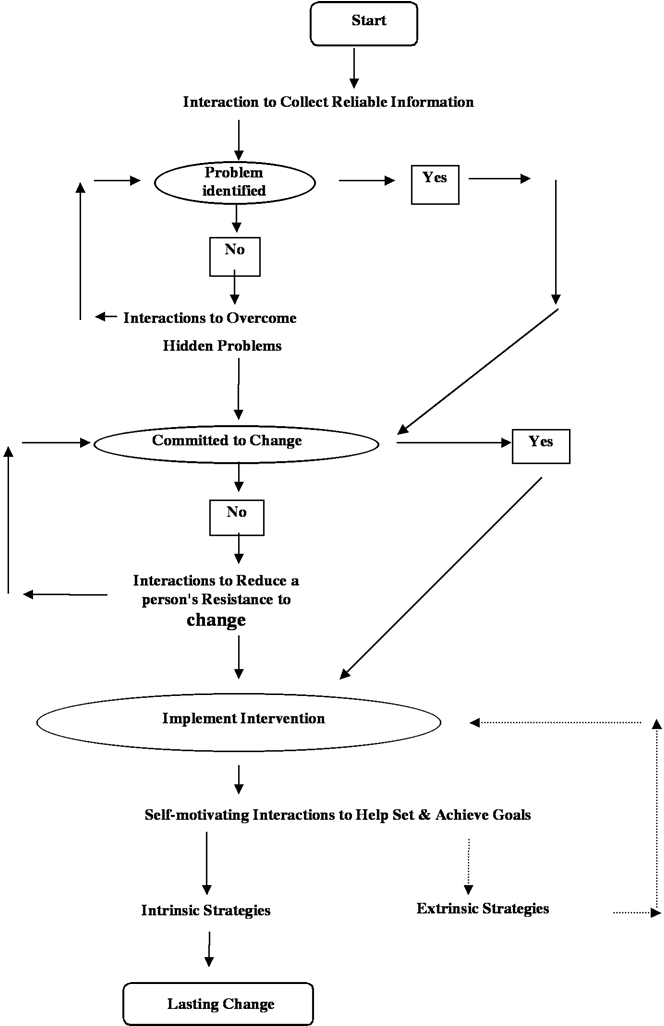
Interactions to collect reliable information (1)
The first step is to interact to collect reliable information that identifies and explains the person's situation. By being a good listener and exhibiting a caring attitude a positive rapport and risk free environment is created with the student. Over time as positive interactions continually demonstrate a safe helping relationship the student will begin to trust that they can share accurate personal information.
Body language can help or hinder the communication. Sit at eye level, make eye contact (if appropriate) lean forward, use open body language, smile, use good tonality, touch (if appropriate), nod and bob.
The amount of time you are willing to spend with the student is a statement of your interest and concern. Interactions that are effective during this stage are open-ended questions, reflective-listening, and closed-ended questions that probe for deeper understanding without building barriers.
Other considerations:
- Surface problems or symptoms
- Underlying problems or causes
- What behavioral theory correlates to the causes?
- Driekurs’ Mistaken Goals Theory
- Six Theories of Behavioral Development
- Glasser’s Theories on Relationships
- Maslow’s Hierarchy of Needs
- Charlie’s Seven Basic Human Needs
Identification of problem (2)
Consider all information and make a decision of what the problem either is or might be. For problems that require investigation and documentation review a Six Step applied behavior analyis management (intervention) plan.
When presenting your considerations of the problem, simply state the problem without judgment or emotional wording.
If you are not sure exactly what the problem is, then discuss your ideas as possible, However, if the problem is serious and evident, then state the problem; and don't negotiate the seriousness of the problem or let the person who should won the problem weasel out of owning it.
Interactions to overcome situations people want to hide (3)
Interactions to overcome people hiding information, may not be necessary, as not all students avoid talking about their problem. Still some will employ numerous strategies and a high degree of skill in hiding what they would rather avoid.
There are a variety of reasons for them to do so. They may be embarrassed, feel guilty, don't want to be wrong, are afraid of other's reaction, or other reasons. It is very hard to help a person solve a problem when they don't or can't share reliable information or information related to the issue.
Interactions that increase students' willingness to share reliable information include the three previous interactions (open-ended questions, reflective-listening or active listening, and closed-ended questions) and two more: positive statements and contradictory statements. Let students know: it is okay to have a problem and you are willing to listen and assist them in finding a solution. (Intent of reflective and active listening)
Positive statements are used to keep the conversation going. To make a positive statement doesn't mean you agree with what the student has said or done. It is simply information stated in a positive manner to probe for additional information or encourage a student to share information that they are hiding. Reassuring, praise and encouragement are also appropriate.
A contradictory statement works in the same as positive statements, only where a positive statement is like catching flies with honey, a contradictory statement may be interpreted as honey or a jolt of reality. In either case they can be effective to get students to talk about something they have been hiding or unwilling to discuss.
Need to keep probing
Other considerations:
- Who owns the problem? Making students aware who is experiencing the concrete effects of the problem and who is not. Allowing them to disassociate from it.
- Who is sending messages and receiving messages.
- Roadblocks that interfere with communicating problem ownership.
- How roadblocks cause students to feel and experience frustration, anger, defensiveness, embarrassment, and lower self-esteem that create increased resistance to change.
- Students may have difficulty expressing how they feel or they might try to avoid incrimination.
Interactions to help people commit to change (4)
Once a situation or problem is identified, and the student accepts the problem, the student must want to change. If the student is willing to make a sincere commitment to change, the next step is to select an intervention that is the least restrictive and intrinsic (see intervention continuum for interventions listed from least restrictive and intrinsic to most restrictive and extrinsic) is selected.
If the student does not commit to change, then the conversation moves to interactions that reduce a person's resistance to change.
Interactions for this step center around a closed question.
Interactions to reduce a person's resistance to change (5)
& interventions to help learners create, implement, and sustain a plan to achieve a goal of mastery oriented behaviors
The types of interactions used to reduce a person's resistance to change so they are willing to accept suggestions for a plan or create a plan, implement the plan, and adjust it as necessary to achieve lasting change fall into two categories.
First, is conversational interactions to support change interventions when students are intrinsic motivated.
Second, is conversational interactions to support change interventions when students are not intrinsically motivated and extrinsic motivation is used as part of an intervention. Each of these have different kinds of conversational interactions to accompany the chosen interventions.
Two paths in the Conversational interaction map represent these interactions: left path, solid arrows, represents extrinsic interventions and the right, dotted path, represents intrinsic interventions.
The right, intrinsic and less restrictive interventions will use more open-ended, reflective listening, empathy, support and more, and encouragement statements.
The left, extrinsic and more restrictive interventions will use more approval, authority, disapproval, I-statements, and praise. However, an extrinsic and more restrictive approach does not need to be limited to these interactions and interventions only.
Whatever kind of interventions used the more caring the tone of the conversation the greater the possibility of lasting change. Therefore, if an intervention starts restrictive and extrinsic, there must be a transition to intrinsic and less restrictive for there to be a possibility of lasting change.
Intrinsically Motivated Example
A student wants to be able to interact with his or her peers in a manner that allows him or her to be accepted. The student has the desire but is lacking necessary knowledge and social skills. It is highly likely that a teacher or counselor can work with this student and help them achieve the expected goal.
Extrinsically Motivated Example
A student refuses to complete work in a timely manner and is not willing to change. For one reason or another the student lacks intrinsic motivation. After sufficient failed conversations to elicit a commitment to change the teacher uses an authority statement to tell the student what they should do and implements an intervention of reward and response cost or punishment to create change. While the intrinsic approach is more acceptable this may be an example when a more restrictive extrinsic approach is necessary.
Each of these examples has different kinds of conversational interactions to elicit a commitment to change.
The first, intrinsic and less restrictive approach uses more open-ended, reflective listening, empathy, support and more, and encouragement statements.
The second, extrinsic and more restrictive approach will use more approval, authority, disapproval, I-statements, and praise. The more directed, coercive, and authoritarian the approach the more likely the interactions will be concentrated around the later kinds of statements. However, an extrinsic and restrictive approach does not need to be limited to those interactions only. The more interactions and interventions used that are less restrictive and more intrinsic, the more caring the tone of the conversation and the greater the possibility of obtaining a commitment to change, if not at first, later. Therefore, conversations and interventions that start extrinsic and restricted must transition to intrinsic and less restrictive to increase the possibility of lasting change.
Summary of verbal statements, questions, and interactions
- Approval statements - Should approve of the qualities or behaviors the person values. Be vary careful to communicate to the student a distinction between qualities and behaviors and the student them self.
- Authority Statements suggest to students what behaviors you disapprove of. However, they can be used when you disapprove of something the student does. Tell them you disapprove of their action(s) and give a rationale for it. An I-Statement might be appropriate. Make sure the student is aware that you disapprove of what the student did not the student themselves.
- Closed-ended questions
- Contradictory Statements
- Disapproval statements can usually be avoided, as students usually know what you approve of and do not. However, if you feel it necessary, then using an I statement might be more appropriate.
- Empathy Statements
- Encouragement
- I Statements
- Interventions
- Open-ended questions
- Positive Statements
- Praise
- Reflective Listening
- Support and More Statements
Management - self development & individual, group, & classroom management