Maladaptive Behavior or Self-limiting
Behavioral Theory
Students do not always choose to be successful. Sometimes they choose behaviors that limit their success. We call this misbehaving or maladaptive behaviors. However, the student is making choices for their emotional needs based on their current skill set and intellectual abilities.
Dreikurs and Cassel (1972) view misbehaving children as discouraged children trying to solve problems with faulty logic that can be shaped by:
- Over ambition: I cannot do as well as I want to.
- Competition: I cannot do as well as others.
- Pressure: I cannot do well when it really counts.
- Failure: I just know I will fail.
For them school or life can become hopeless. They feel weak and helpless and choose behaviors that most often produce failure. Each failure contributes to a feeling of pessimism; and others interacting with them may treat them as weak and useless. This treatment confirms their perception of themselves. Continued confirmation of their perception perpetuates the self-limiting or maladaptive behavior that defeats them as illustrated in a self-fulfilling prophecy or self-fulfilling cycle.
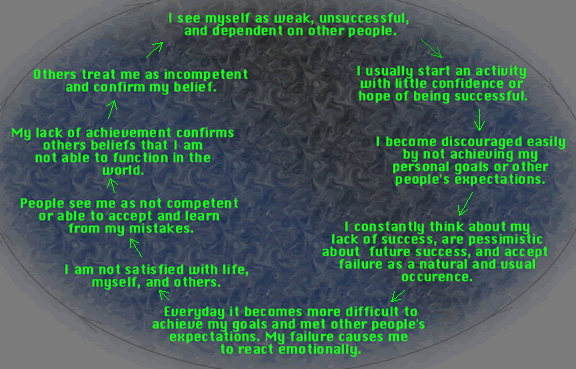
Self-fullfilling prophecy or self-fulfilling cycle
Interventions
Talk with students to help them set realistic goals, and use encouragement to help them develop positive feelings about their achievements. Doing this enables students to make wise choices and is the best antidote for the debilitating effects of a cycle of defeat.
A belief in helplessness and powerlessness must be replaced by a belief in their self-efficacy. Only such a belief brings renewed faith in oneself and a sense of adventure in living. See intervention suggestons for maladaptive behaviors by power, teacher's reactions, and student's reactions in the table below and discussion for each goal below the table.
Intervention suggestons for maladaptive behaviors
| Goal | What a student is feeling | How the teacher feels | Student's reaction to coercion | Other strategies to use |
|---|---|---|---|---|
| Attention |
|
Annoyed Desire to remind, plead, coax, boss, and make the person do what they believe is "right". |
|
|
| Power |
|
Provoked or threatened Want to make the student do it or do not want the student to get away with something. |
|
|
| Revenge |
|
Hurt or mad How could this happen? |
|
|
| Inadequacy |
|
Despair Don't want to try. |
|
|
Four categories of maladaptive behavior
Attention-getting behaviors
Attention-getting behaviors result when students feel they are not having their emotional needs met. The attention-getting behaviors provide them relief from routine, escape from responsibility, and enlarge the boundaries of acceptable behavior. Students seldom consider the costs. Their behavior seems a logical way to be a part of a group by giving them a mistaken sense of significance and belonging. Only when noticed do they feel accepted and if the teacher and or students ignore them, they may escalate the frequency, duration, or intensity of their behavior.
Punishment, to make them think twice before they do it again, will give them the attention they seek.
Time-out that deprives them social stimulation may increase their desire for attention when they return, and require even more energy to refrain from misbehaving, or a greater desire to get needed attention. Some teachers recognize this and provide students the attention they seek through academic activities. They find constructive worthwhile activities in which the student will choose to be involved.
In a teacher centered classroom the teacher will involve the student by having them take attendance, collect work, pass out papers ...
In a student centered classroom the teacher diagnosis the student's needs and guides the student's explorations to acquire attention through their achievement rather than self-limiting attention getting behaviors.
Power-seeking behaviors
Power-seeking behaviors result when the student does not get attention and acts out of jealousy or envy to keep anyone from looking good or being in control. The student seems to decide that if they can’t be number one, then no one will be. They try to prove they can't be controlled and only they will decide what they do.
An inexperienced person may try to control them by establishing superiority. That is not the best solution. As long as both parties view the situation as a win-lose situation there can be no reconciliation. The educator must refuse an emotional conflict and look for ways to de-escalate the conflict, withdraw from provocation and invite conversation for negotiations. Most students do not want an emotional conflict but if backed into a corner they will be left with no alternative. After each conflict the student has learned more about the teacher or other person’s vulnerability and how to provoke future incidents. The teacher must give and share power to support responsible behavior.
In a teacher centered classroom the teacher often keeps the power and students who feel controlled may resort to power-seeking behaviors.
In student centered classrooms the teacher will find ways to share and give power to the students and keep the power only when necessary. These teachers listen to students to find their interest, their developmental levels, and what they know. Then, use that information to suggest activities that meet the student needs, give student choices, and allow the student to construct meaningful knowledge. Students who desire power often have very good leadership qualities that can be enlisted beneficially.
Revenge behaviors
Revenge behaviors result when the student feels they have lost control, that they have been controlled by another, and seek to punish them. By getting even or hurting them they feel satisfied for the indignity caused them. They are not out to prove themselves at all costs, but desire to discredit or hurt the person who has control, no matter what it cost them.
People who try to control them are tempted to return hurt for hurt. However, we must refuse to retaliate so as not to destroy self-esteem, and cause other students to root for the underdog, and boo the bullying teacher. A student so discouraged and desperate lacks a sense of belonging or significance. A student will give up revenge behaviors when she has a sense of significance and belonging so when they are invited to belong to a community, they will understand that reciprocity kindness, understanding, and cordiality, are ingredients for healthy communities.
The teacher’s attitude might be: You do this to me because you know I will return hurt with help.
In a child centered classroom a teacher communicates with students and avoids most revenge behaviors.
In a teacher centered classroom the teachers may desire to win a power struggle and often contribute to revenge-seeking behaviors.
Display-of-inadequacy behaviors
Display-of-inadequacy behaviors are seen in students that are physically present but withdraw from interacting with the intellectual ideas of the school community and become emotionally absent. They are content to let the educator have their way but choose passive resistance to express their dissatisfaction, discontent, defiance, or defeat. They know the educator can not force them to whole-heartedly cooperate and learn. They mistakenly believe that if they do nothing they avoid the hurt of trying to achieve what they believe is not possible and their inevitable failure.
Teachers may decide to let them alone since they are not causing trouble and invoke temporary measures by helping as time permits, but have no long range plan for helping them learn how to set and achieve appropriate goals. An appropriate plan is to help students set acceptable goals, teach them necessary skills, encourage them to feel the positiveness of change, and achieve a little more each day. Care must be used in increasing requirements. Some students are fearful of the need to do a bit more each day and not being able to meet increasing demands. They see their teachers; and parents’ expectations as goals that are expanding faster than their growth and self-efficacy. Unconditional love gives students the ability to feel they can be loved without the need to constantly do better.
For more specific suggestions for all four maladaptive behaviors, see intervention suggestons in the table above.